
The short answer: ethical catering means a caterer can explain how it treats the people who work for it, where its ingredients come from and what happens to food that is not eaten. Composting only answers part of that last question. In California, SB 1383 already pushes food businesses to recover surplus edible food for people rather than let it go to waste, although whether the law applies to a particular caterer depends on how the local jurisdiction classifies it.
This article explains what that law says, where the evidence is clear and where it is not, and how to ask a caterer sensible questions about labour, sourcing and waste.
Key Takeaways
- Ethical catering has at least three strands: how people are treated, how ingredients are sourced, and how surplus food is handled.
- A compost bin deals with food after it has failed to feed anyone. California law is now aimed at getting edible food to people first.
- SB 1383 sets a statewide target of recovering at least 20% of currently disposed edible food for human consumption by 2025, alongside a 75% cut in organic waste disposal from the 2014 level.
- Large food generators in Tier 1 and Tier 2 must recover the maximum amount of edible food, hold a written agreement with a food recovery organisation or service, and keep monthly records.
- Whether SB 1383 covers a caterer depends on local classification. Do not assume that every caterer is included, and confirm with the local jurisdiction.
- For labour and sourcing, the best tool a client has is a clear set of questions put to the caterer, and honest answers in return.
What ethical catering actually covers
The word ethical is used loosely in food. Some caterers use it to mean organic ingredients. Others mean recycling, or reusable serving ware. None of these is wrong, but each covers only a slice of the picture.
A useful way to think about ethical catering is as three connected questions.
- People: how are the cooks, servers, drivers and event staff treated, and is that treatment fair and open?
- Ingredients: where does the food come from, and can the caterer describe its sourcing honestly and specifically?
- Surplus: when more food is prepared than guests eat, what happens next, and how much effort goes into preventing that situation in the first place?
Search results for terms such as fair labor catering, responsible sourcing catering and environmentally friendly catering tend to blur these together. Keeping them apart makes it easier to judge a caterer’s claims. A business can be strong on one strand and weak on another, and a single green badge on a website does not tell you which is which.
Why the compost bin is not the end of the story
Composting has become the visible symbol of sustainable events. Guests see the bins, the signs and the sorting stations, and it feels like action.
The difficulty is that a compost bin is where food ends up once every other option has failed. If a tray of well-prepared, safely handled food goes into it, the food has been wasted as food, even if the material is later put to use. The ethical question is earlier in the chain: why was that much food made, and could someone have eaten it?
California’s law reflects this shift. Rather than stopping at organic waste going to compost, it also sets a goal for edible food to be recovered for human consumption. That is the clearest official sign that the conversation has moved beyond the bin.
What California SB 1383 says
SB 1383 was signed by Governor Brown in 2016. According to a notice from Orange County Waste & Recycling, its purpose is to reduce greenhouse gas emissions, including methane from organic waste, and it sets goals for businesses to recover the maximum amount of surplus edible food for human consumption.
The law sets two statewide targets, as set out in a CalRecycle slide deck on edible food recovery (hosted by LA County Public Works):
- A 75% reduction in organic waste disposal from the 2014 level by 2025.
- At least 20% of currently disposed edible food recovered for human consumption by 2025.
The first target is about keeping organic material out of landfill. The second is about food access. Together they explain why the law cannot be satisfied by composting alone. A business that diverts all its food scraps to compost has dealt with the first aim but not the second.
Key dates
The requirements were phased in. According to San Benito County’s integrated waste management page, Tier 1 edible food generators have had to comply since 1 January 2022, and Tier 2 generators since 1 January 2024. The City of Buena Park’s edible food recovery page corroborates these dates.
The law also requires local jurisdictions to run outreach and inspection programmes. In practice, that means your city or county is the body that explains the rules locally and checks that they are being followed.
What covered businesses must do
For businesses that fall into Tier 1 or Tier 2, the obligations are specific. Local government pages, including those of the City of El Centro and San Benito County, describe them as follows.
- Recover the maximum amount of edible food that would otherwise go to landfill.
- Hold a written contract or agreement with a food recovery organisation or service.
- Keep records of the type of food, how often it is recovered and the pounds recovered each month.
Two details are easy to miss. First, the law does not require all excess food to be donated. Second, covered businesses must not intentionally spoil edible food, which closes off the idea of making surplus food unusable so that it can be thrown away.
Food safety also matters. San Benito County notes that donated food must meet California Retail Food Code safety requirements. Recovery is not a licence to hand over anything left on a buffet. Food has to be handled so that it is still safe to eat.
Does SB 1383 apply to a caterer?
This is the part where it pays to be careful, because the answer is not the same everywhere.
The City of Diamond Bar’s edible food recovery page lists food catering establishments and food service providers as Tier 2 generators. By contrast, the Buena Park page defines Tier 2 only as large hotels and restaurants of 5,000 square feet or more, or with 250 or more seats. It does not name caterers at all.
Those two pages sit side by side, yet they give different impressions. Coverage appears to depend on how each local jurisdiction classifies food businesses. SB 1383 may therefore apply to a caterer, but it does not necessarily apply to every one.
This article does not state how Santa Clara County or the City of San Jose classify caterers. If you run a food business, or you are a client who wants to understand a caterer’s obligations, the sensible step is to confirm the classification directly with the local jurisdiction. The same applies if you work in San Francisco or elsewhere in the Bay Area, since each area handles its own outreach and inspection.
It is also worth checking current text from CalRecycle. The sources used here are local government pages and a CalRecycle presentation of varying dates, and rules or guidance can change.
Preventing surplus is part of the ethics too
Recovery rules deal with food that already exists. A thoughtful caterer also asks how much to make in the first place.
At Caterman, we plan thoughtfully to reduce food waste. For us that means decisions about menu and quantities are made before the event, rather than after the last guest has left. The less surplus a plan creates, the less there is to manage, whether that is through recovery, composting or anything else.
We are a full-service catering and event planning company based in San Jose, serving San Jose, San Francisco and the wider Bay Area since 1997. More than 80% of what we serve is prepared from scratch in our San Jose kitchen. Cooking most of the menu in one kitchen means the people planning the food and the people making it are working from the same plan, which is useful when quantities need to be right.
Planning also has to account for the people eating. We accommodate dietary needs including halal, vegetarian, vegan and common allergies. Getting those needs right in advance helps avoid two kinds of waste: food that guests cannot eat, and last-minute substitutions that nobody planned for.
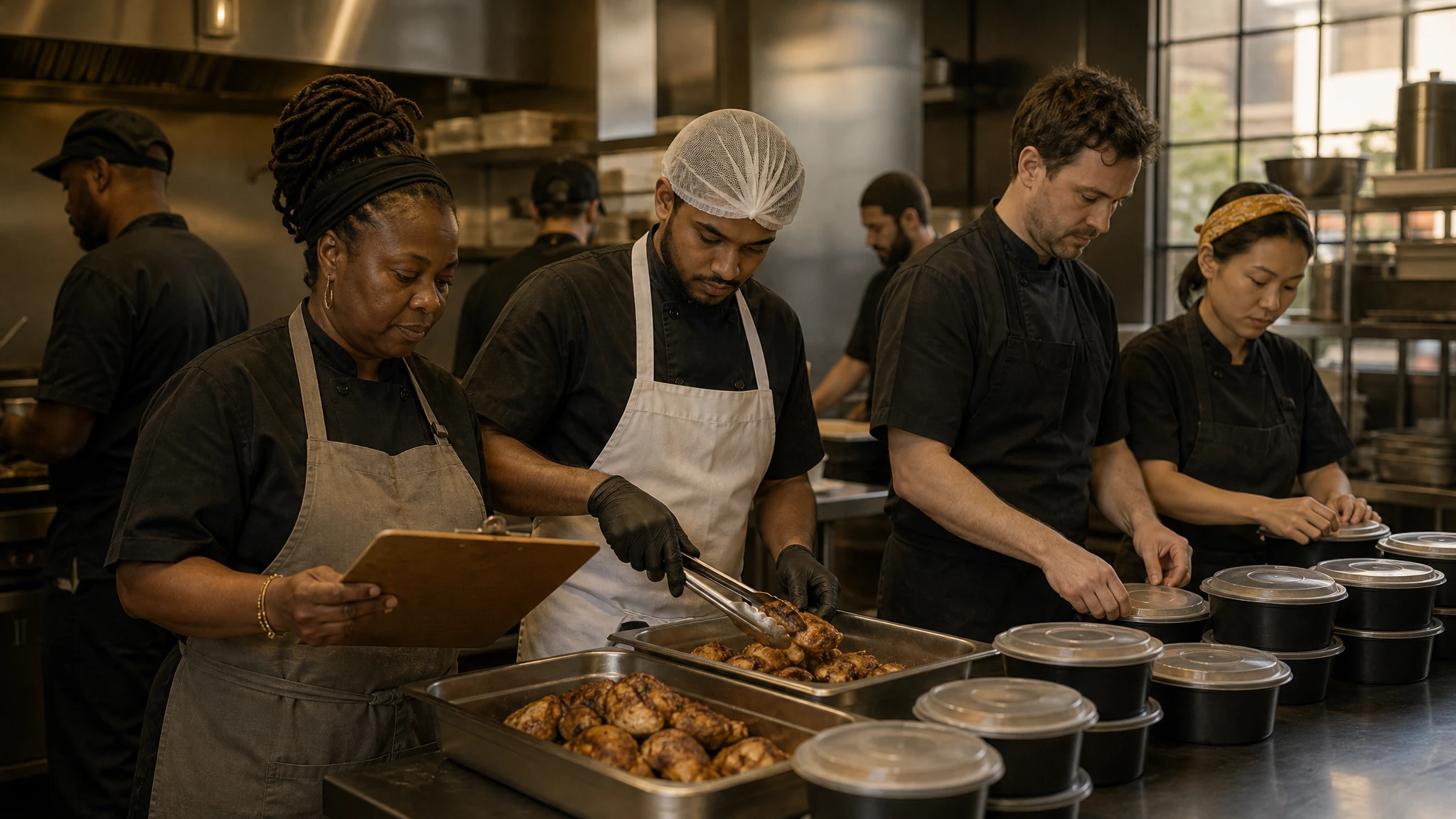
Fair labour: what to ask about the people behind the food
Fair labor catering is the strand that clients see least. Guests notice the food and the service on the day, but they rarely see the preparation hours before or the clearing up after.
This article does not set out California or San Jose wage rules, overtime rules, tip and service-charge rules or food-handler card requirements. Those are matters of employment law, and you should check them against official government sources rather than relying on a general article. What a client can do is ask questions and judge the quality of the answers.
- Are the people serving at my event employed directly by the caterer, or supplied by another company?
- If a service charge or gratuity appears on a proposal, how is it explained, and where does it go?
- How long are shifts likely to be on the day, including setup and breakdown?
- Who is the named person responsible for the team on site?
You are not looking for a perfect speech. You are looking for a caterer that answers plainly, without defensiveness, and in a way that matches what is written in the proposal. A business that treats its staff well is usually comfortable talking about it. Vague or evasive replies are worth noting.
Responsible sourcing: what the words should mean
Responsible sourcing catering is a phrase that can mean almost anything unless it is pinned down. Terms such as local, sustainable, seasonal and organic carry different meanings in different mouths, and some have formal definitions while others do not.
This article does not define those terms or recommend particular certification schemes. The point here is more practical: if a menu uses a sourcing word, you are entitled to ask what it means for that dish.
- Which items on the menu does this claim apply to, and which does it not?
- If something is described as local, what area does that mean?
- For the main protein, can the caterer tell you where it comes from?
- If a claim depends on a certification or label, can the caterer name it?
A caterer that cooks most of its food from scratch is in a better position to answer these questions, because the ingredients pass through its own kitchen rather than arriving ready-made. At Caterman, more than 80% of what we serve is prepared from scratch in our San Jose kitchen. That does not, on its own, say anything about where each ingredient was grown, and we would not ask you to assume it does. It simply means ingredient questions can be discussed in terms of a menu we prepare ourselves.
Be clear about what the caterer is not supplying
Sourcing questions apply only to what a caterer actually provides. Two common examples show why this matters.
- Cake: we do not bake or supply the cake. We provide cake service, which means cutting and plating the cake from your own baker. Questions about the cake’s ingredients and how it was made belong with your baker.
- Alcohol: we provide bartenders and a full bar setup, but we do not sell or supply alcohol. You supply it and we serve it, so decisions about what to buy and from whom are yours.
Being honest about this boundary is part of ethical practice. A caterer should be clear about what it makes, what it serves on someone else’s behalf and what it leaves to the client, so that no one is misled about responsibility for each part of the event.
Environmentally friendly catering beyond waste
Environmentally friendly catering is wider than what happens to leftovers, but waste is the strand where the evidence in this article is strongest. The SB 1383 targets are explicitly tied to cutting greenhouse gas emissions, including methane from organic waste.
This article does not cover California rules on single-use foodware, local ordinances in San Jose, or the federal guidance on food recovery. If those matter to your event, check them with the relevant authority. In the meantime, a few general questions help you see how a caterer thinks about environmental impact.
- How does the caterer decide on quantities, and how does that process reduce surplus?
- What happens to food that is prepared but not served?
- How are dietary needs planned for, so that special meals are made in the right numbers?
- Can the caterer explain its approach without relying on slogans?
The strongest signal is usually specificity. A caterer that can describe the planning behind its decisions is likely to have given them real thought. One that offers only general phrases may not have.
How to put this into practice
You do not need to become an expert in waste law to choose a caterer sensibly. A short list of questions, asked early, covers most of the ground.
- Ask about planning. How does the caterer set quantities, and what is done to reduce waste before the event?
- Ask about surplus. What happens to prepared food that is not served, and does the caterer have an arrangement for recovering it?
- Ask about local rules. Does the caterer know whether SB 1383 applies to its business, and how its local jurisdiction classifies it?
- Ask about people. Who will work the event, how are they engaged, and how is any service charge explained?
- Ask about sourcing words. If the menu says local, seasonal or sustainable, what does that mean for each dish?
- Ask about boundaries. Which parts of the event, such as cake or alcohol, is the caterer serving but not supplying?
Listen for consistency as well as content. A caterer that gives the same account in conversation, in writing and on the day is easier to trust than one whose answers shift.
Also bear in mind that a good answer may be a limited one. A caterer might say that a certain claim does not apply to part of the menu, or that it has not yet settled how it handles a certain kind of surplus. An honest limit is more useful than a confident claim that falls apart under a second question.
What the evidence does and does not show
It is worth being clear about the limits of what has been covered here.
The edible food recovery rules are well documented by state and local government sources. The targets, the effective dates and the core obligations are consistent across several local pages. The question of whether a caterer is covered is genuinely unsettled, and it varies with local classification.
The other two strands, labour and sourcing, are not backed by specific legal or regulatory detail in this article. That is deliberate. Wage rules, food-handler requirements and food-labelling rules each have their own official sources, and they deserve to be read directly rather than summarised from memory. The questions above are meant to help you start a conversation, not to replace that reading.
If you are planning an event in San Jose, San Francisco or elsewhere in the Bay Area and want to talk through menu planning, dietary needs and how to keep waste down, that conversation is a good place to start. Ethical catering is not a badge. It is a set of decisions, and each of them can be asked about.
Frequently Asked Questions
What is ethical catering?
Ethical catering is catering in which the caterer can explain how it treats its staff, where its ingredients come from and what it does with surplus food. It covers more than composting or recycling.
Does California law require caterers to donate leftover food?
Not in every case. SB 1383 applies to edible food generators in Tier 1 and Tier 2, and whether a caterer falls into one of those tiers depends on the local jurisdiction. Where it does apply, the law does not require all excess food to be donated, but covered businesses must recover the maximum amount of edible food and must not intentionally spoil it.
Is composting enough to make catering environmentally friendly?
Composting is one part of the picture, but SB 1383 also sets a target of recovering at least 20% of currently disposed edible food for human consumption by 2025. That means preventing surplus and feeding people come before the compost bin.
How can I check whether a caterer is sourcing responsibly?
Ask what specific sourcing words on the menu mean for each dish, which items they cover and which they do not, and whether any claim relies on a named certification. A clear, consistent answer is a better sign than a general statement.
Further reading
For the official detail on edible food recovery, start with the CalRecycle edible food recovery presentation and your own city or county’s SB 1383 page, since local classification determines who is covered.