
The short answer: a custom catering menu comes together in stages. You share the purpose, size and setting of your event, the caterer asks about your guests and their dietary needs, a menu is drafted and refined, and the kitchen and service teams then plan how every dish will be prepared, transported and served. Each stage narrows the choices until the menu fits your event, your guests and the practical limits of the venue.
Key Takeaways
- A custom catering menu is built around your event and guests, not chosen from a fixed list.
- The process usually runs through a brief, dietary and allergen intake, menu design, revisions and logistics.
- Dietary needs such as halal, vegetarian, vegan and common allergies are best raised at the start, because they shape the whole menu.
- In California, catering is defined in the state food code, and food staff are required to understand food safety, including major food allergens.
- Practical points such as which dishes are finished onsite, cake service and bar service are decided during planning, not on the day.
- Allergen disclosure rules are changing, so ask your caterer how they handle allergen information for your event.
What a custom catering menu actually is
A custom catering menu is a menu designed for one specific event. Instead of picking a package, you and the caterer decide together what is served, in what order, in what style and for which guests.
You will see the same idea described in different ways. Some companies talk about bespoke catering services, others about custom corporate catering for offices and company events. People searching for bespoke caterers are usually looking for the same thing: a team that will build a menu around their needs rather than ask them to fit into a template.
Custom does not mean unlimited. A good menu still has to work in a real kitchen, travel well, hold its quality and be served within the time and space the venue allows. Much of the skill in building one lies in balancing what you want with what can be done well.
At Caterman, a full-service catering and event planning company based in San Jose and serving the Bay Area since 1997, menus are planned with this balance in mind. The sections below describe how a menu typically develops, from first conversation to service.
Step 1: The brief, or what the menu is for
Every custom menu starts with questions about the event itself. The answers decide the style of food before a single dish is named.
Typical points to cover include:
- The occasion. A wedding reception, a product launch, a team lunch and a memorial gathering all call for different food and different pacing.
- The guest count. Numbers affect which dishes are practical. Some dishes suit a small seated dinner but are hard to produce well for a large crowd.
- The venue. A venue with a full kitchen allows more finishing onsite. A venue without one means more preparation happens before the food arrives.
- The format. Plated courses, buffet, stations, family-style service and passed canapés each shape the menu in a different way.
- The timing. The time of day, the length of the event and the schedule of speeches or activities all matter.
- The tone. Formal, relaxed, celebratory or low-key. The food should feel right for the room.
It helps to arrive with a rough idea of what you like and what you want to avoid. If you have an event where the food will be remembered for a particular reason, such as a cultural tradition or a family recipe, say so early. These details are hard to add late.
What to bring to the first conversation
You do not need a finished plan. A date, an approximate guest count, a venue or short list of venues, and a sense of the style you want are enough to begin. Where you are undecided, a caterer can usually explain the options and what each would mean for the menu.
Step 2: Understanding your guests
The next stage is about the people who will eat the food. A menu that suits the host but leaves several guests with little to eat has not done its job.
Useful questions include whether guests are mostly local or travelling, whether there are children, whether the group is mixed in age, and whether the event is a long meal or a shorter gathering. For custom corporate catering, it also helps to know whether the food is for a working meeting, a client reception or a team celebration, as each sets a different expectation for how people eat and how long they stay.
Dietary needs come first, not last
Dietary requirements are not an afterthought in a custom menu. They are part of the design. Caterman accommodates halal, vegetarian and vegan diets, along with common allergies, and these needs are easiest to meet well when they are known at the start.
There is a practical reason. If a vegan option is added to a finished menu, it often ends up as a side dish pulled together from what is already planned. If it is considered from the beginning, it can be a proper dish that sits alongside the others and is enjoyed as much.
The same applies to halal requirements. Knowing early how many guests need halal food, and what that means for them, lets the kitchen plan ingredients and preparation properly rather than adapt at the last minute.
When you gather dietary information from guests, try to be specific. “No nuts” can mean a preference, an intolerance or a serious allergy, and the kitchen will plan differently for each. Passing on the exact details, as your guests gave them to you, is more helpful than a summary.
Step 3: Allergens and why they are part of the process
Allergen questions are a routine and important part of building a custom menu. They are also a matter of law for food businesses in California.
The California Retail Food Code, known as CalCode, sets out the state’s food safety rules. According to the Sacramento County Environmental Management Department’s guidance on food allergens, CalCode section 113947 requires the person in charge and all food employees to have adequate knowledge of food safety as it relates to their duties. That requirement has been expanded to include knowledge of major food allergens, which CalCode section 113820.5 defines. The guidance document carries no stated date, so check the current version of the code if you need exact wording.
In practice, this means the people preparing and serving your food are expected to understand allergens as part of their job. For you, it means that being asked about allergies is normal. It is not a courtesy that a caterer can skip.
How allergen information shapes a menu
Once allergens are known, they influence several decisions:
- Which dishes are suitable for a guest with a particular allergy.
- Whether a dish can be adapted or whether a separate dish is better.
- How food is labelled or described at the event, so guests and servers know what each dish contains.
- How the kitchen and service team organise preparation and serving to avoid mixing allergens into foods that should be free of them.
The 2026 text of CalCode also refers to allergen cross-contact in food preparation, but the portions reviewed for this article were incomplete. For that reason, treat the general point as the reliable one: handling allergens correctly is part of the food-safety knowledge that food staff need.
Allergen disclosure rules are still developing
You may have read about newer legislation on allergen information. California bill SB 68, in its amended 2025 text, proposes adding sesame to the state’s list of major food allergens and adding a new Health and Safety Code section, 114093.5. It describes a written notice placed below or next to a menu item that lists the major food allergens the item contains.
That text is an amended bill, not a confirmed final statute, and the page reviewed did not show a final version or an effective date. It is also not clear from the sources reviewed whether any such notice requirement would apply to catering operations. This article therefore does not say that it applies to any particular caterer. If allergen notices matter to your event, ask your caterer directly how they provide allergen information to your guests.
Step 4: Designing the menu
With the brief and the guest needs in hand, the menu itself can take shape. This is usually a drafting process, with a first proposal followed by changes.
Starting from structure
Most caterers begin with the structure of the meal rather than individual dishes. How many courses, or how many stations? Will there be canapés before the main service? Is there a dessert course, a late-night snack, or both? The structure sets the rhythm of the event and tells the kitchen how much needs to be produced and when.
Choosing dishes that suit the format
Dishes are then matched to the format. Some food is at its best straight from the oven, some holds well on a buffet, and some is designed for eating standing up with one hand. A menu for a seated dinner will look quite different from one for a standing reception, even if the flavours are similar.
Balance matters too. A well-built menu offers variety in texture, colour and richness, and does not repeat the same main ingredient across several courses. It also includes enough choice for guests with different diets without making the menu confusing.
Cooking from scratch
At Caterman, more than 80% of what we serve is prepared from scratch in our San Jose kitchen. For menu design, this has a practical meaning: the dishes on your menu can be developed and adjusted in the kitchen, rather than being limited to a fixed set of ready-made items. If you want a sauce without a certain ingredient, or a dish adapted for a dietary requirement, there is a kitchen where that work can be planned.
Seasonal and local thinking
Many clients like a menu that reflects the time of year. Seasonal ingredients are a natural starting point for discussion, and they can suggest dishes you might not have considered. Availability can change, so a menu is best treated as a plan that may need small adjustments as the event date approaches.
Step 5: Planning around the kitchen and the venue
A menu on paper is not yet a catering plan. The next stage is deciding what happens where, and this is where catering differs from restaurant cooking.
California’s food code gives a useful picture of this. CalCode section 113739.1 defines a catering operation as a food service run by a permanent food facility approved for food preparation, where food is served, or limited preparation is done, as part of a contracted offsite food service event. The same section says that takeout or delivery food that the customer serves themselves is not a catering operation. You can read the wording in the 2026 California Retail Food Code as published by Alameda County, effective 1 January 2026. The same text appears in the Orange County Health Care Agency copy, updated 16 March 2026.
For you, the useful point is that catering is built around an approved kitchen and a contracted event. This is why menu choices, such as which dishes are prepared fully in the kitchen and which are finished at the venue, are planned with food-safety rules in mind and not left to improvisation on the day.
What gets decided at this stage
- Kitchen versus onsite. Which dishes are prepared in advance and which are finished at the venue.
- Transport. How food will travel, and which dishes travel well and which do not.
- Equipment. What the venue provides and what the caterer needs to bring.
- Timing. The order in which dishes need to be ready and how many service staff are needed to serve them.
- Access. Loading routes, setup time and any restrictions at the venue.
This is also the stage where a dish may be changed. A dish that would be excellent in a restaurant can be a poor fit for a venue with no cooking facilities. A good planner will say so and suggest an alternative that keeps the spirit of the original idea.
The Caterman team works across San Jose, San Francisco and the wider Bay Area, and venues in each differ widely in layout and facilities. Looking at the venue early avoids surprises later.
Step 6: Revising and confirming the menu
A first draft is rarely the final menu. Expect some back-and-forth.
Clients commonly ask to swap a dish, change the balance between meat and vegetarian options, adjust portions of a course or rethink the order of service. Guest numbers may change, and new dietary needs may come up. This is normal and is part of what makes a menu custom.
A few habits make revision smoother:
- Give feedback on the whole menu, not only individual dishes. A comment such as “it feels too heavy” is useful, because it lets the planner rebalance the whole menu.
- Share updates to the guest list and dietary needs as soon as you have them. Late changes are harder to absorb than early ones.
- Ask what a change affects. Swapping one dish can alter preparation, timing or equipment, and it is better to know before you decide.
- Confirm in writing. A final menu that both sides have reviewed reduces confusion on the day.
Once the menu is confirmed, planning turns from design to delivery: ordering, preparation schedules, staffing and a service plan.
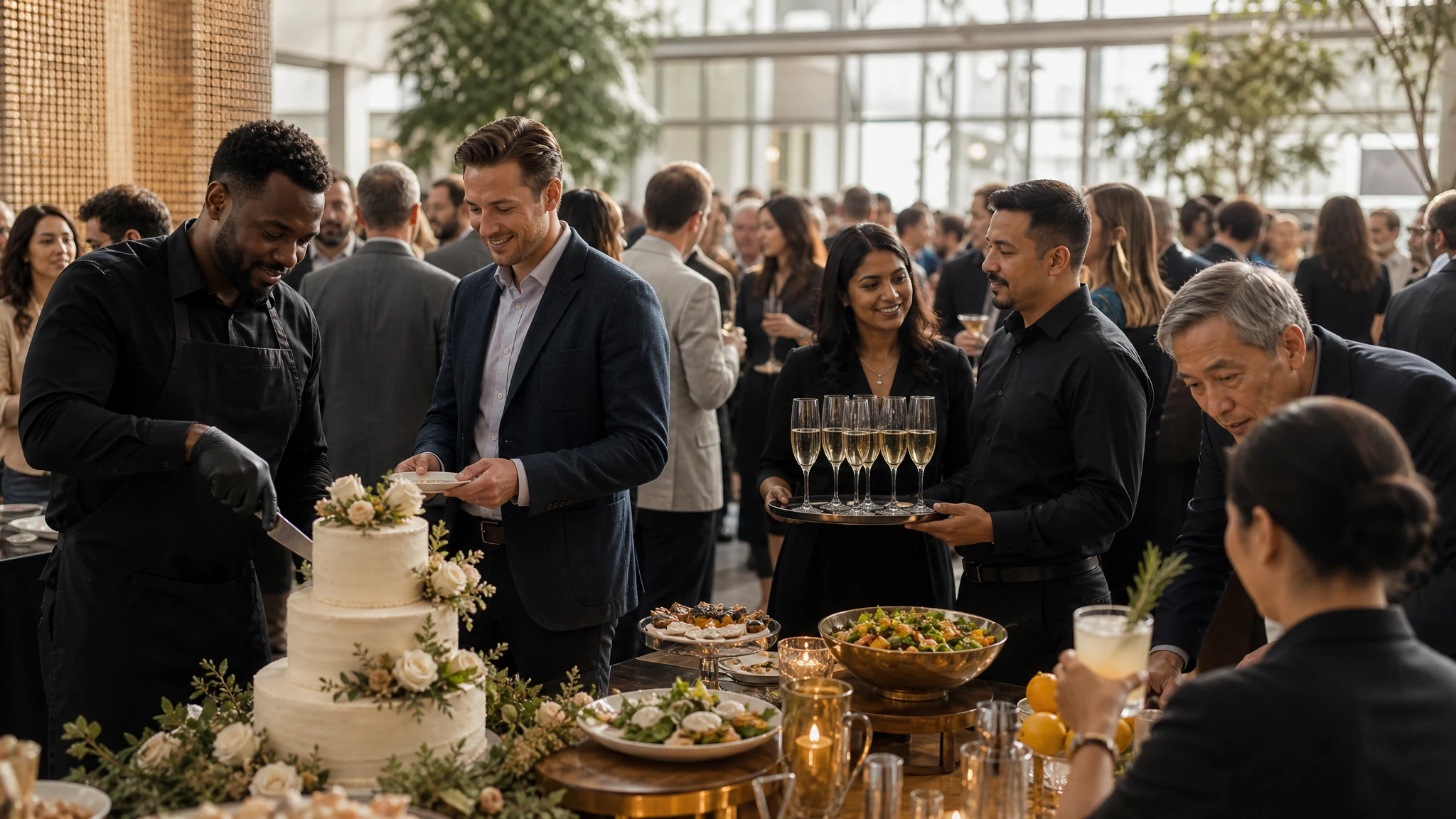
Step 7: Service, cake and bar
Menu planning does not stop at the food. The way it is served is part of the design, and some services are worth clarifying early because they are often misunderstood.
Cake service
Caterman does not bake or supply the cake. If your event includes a cake from your own baker, we provide cake service: cutting and plating it for your guests. Mention the cake early so the dessert course, the timing and the plates can be planned around it.
Bar service
For drinks, Caterman provides bartenders and a full bar setup, but does not sell or supply alcohol. You supply the alcohol and we serve it. If you want a custom bar menu, such as a short list of cocktails, the plan should cover what you will buy, so that the bar team can set up properly.
Service style and staffing
The number of servers, how food is presented and how quickly each course goes out all follow from the menu. A plated dinner needs a different team from a buffet. A menu with many small components, such as a canapé round, needs more hands than one with a single main dish. Discussing the service style with the menu means the two fit each other.
Planning to reduce food waste
Part of building a menu is deciding how much to prepare. Too little is a failure of hospitality, and too much is wasteful. Caterman plans thoughtfully to reduce food waste, and menu design is one of the main ways this happens.
Simple choices help. Using ingredients across several dishes, matching portions to the format of the event, and confirming guest numbers as late as is practical all reduce surplus. The accuracy of your guest count and dietary information has a direct effect here, which is another reason to share it clearly and update it promptly.
Custom corporate catering: what is different
Custom corporate catering follows the same stages, but several points get more weight.
- Mixed groups. Company events often include people with a wide range of diets and preferences, so the menu needs broad appeal without losing quality.
- Schedule. Meetings and conferences run to a timetable, so food needs to be ready and served at fixed points, and service should not interrupt the agenda.
- Ease of eating. Food that can be eaten while talking, standing or working is often a priority.
- Repeat events. If a company hosts regular events, a menu can be developed over time, rotating dishes and adjusting for feedback.
- Clear contacts. One person who confirms numbers, dietary needs and timing keeps things simple.
The principle is the same as for a private event: the menu is built around the purpose of the occasion and the people attending it.
What to look for in bespoke caterers
If you are comparing bespoke caterers, the questions you ask are more useful than the labels they use. Consider asking:
- How do you begin building a menu for a new event?
- How do you handle dietary requirements and allergens, and how is that information passed to the people preparing and serving the food?
- Which parts of the menu are prepared in your own kitchen?
- What do you need to know about the venue, and how do you assess it?
- How many rounds of changes are normal, and how late can guest numbers be updated?
- Which services do you provide, and which do you not? For example, does the cake or the alcohol come from you or from the client?
- How do you plan quantities to limit waste?
Clear, specific answers suggest that the caterer has a process. Vague answers are a reason to ask more.
Common mistakes when planning a custom menu
- Leaving dietary needs until late. It limits the options and can lead to compromises.
- Overloading the menu. More dishes do not make a better menu. A smaller number of well-made dishes usually serves guests better than a long list.
- Ignoring the venue. A menu that does not fit the space or facilities creates problems on the day.
- Assuming everything is included. Check what is and is not part of the service, such as cake supply or alcohol.
- Changing numbers without telling the caterer. It affects quantities, staffing and waste.
A simple timeline of the process
- Initial conversation. You describe the event, guest numbers, venue and style.
- Guest and dietary intake. You share diets and allergies, including exact details.
- First menu draft. The caterer proposes a structure and dishes.
- Revisions. You respond, and the menu is adjusted.
- Logistics planning. Kitchen preparation, transport, equipment, staffing and service style are mapped out.
- Final confirmation. Menu, numbers and dietary needs are confirmed.
- Service. The team prepares, sets up and serves, including any cake service or bar service you have agreed.
The time each stage takes depends on the size and complexity of the event, so ask your caterer what they would need from you and by when.
Frequently asked questions
What is a custom catering menu?
It is a menu designed for one specific event, built around its purpose, guests, venue and dietary needs, rather than selected unchanged from a fixed list.
Do I need to know exactly what I want before I contact a caterer?
No. A date, a rough guest count, a possible venue and a sense of the style are enough to begin. The caterer can help you narrow the choices from there.
How are allergies handled in a custom menu?
They are raised at the start and shape the dishes, the labelling and the way food is prepared and served. In California, food employees are required to have adequate food-safety knowledge, which now includes major food allergens. Give your caterer the exact details your guests supply.
In summary
A custom catering menu is the result of a sequence of decisions: what the event is for, who is coming, what they can and cannot eat, how the food will be made and served, and how it fits the venue. Taking those decisions in order, and sharing information early, gives you the most control over the result.
Whether you are planning a private celebration or custom corporate catering for a company event, the same approach applies. Be specific about your guests, be clear about what you need, and ask how the caterer will handle each stage.