
The short answer: good workshop catering for a full training day keeps lunch moderate, offers lighter food in the afternoon, and builds breaks around the programme rather than around the kitchen. Food cannot cure the afternoon slump, because the slump is partly biological. A sensible menu and a sensible schedule can, however, avoid making it worse.
This guide is for anyone organising training day catering for a team, a client group or a mixed audience. It covers what the available research does and does not say, how to shape the day from arrival to close, how to handle dietary needs, and what to tell your caterer before the menu is set. It also touches on all day meeting catering more generally, since the same principles apply.
Key Takeaways
- The afternoon slump is not only about food. Biology, sleep and workload all play a part, so no menu can remove it.
- A large lunch is associated with a bigger drop in afternoon mental performance than a small meal, so aim for moderate portions.
- Evidence on which foods or nutrients help is mixed. Be wary of any caterer or article that promises a "brain food" fix.
- Skipping lunch is not a solution. Plan a proper, well-timed break instead.
- Collect dietary needs at registration, including halal, vegetarian, vegan and allergies, and tell your caterer early.
- Match the food to the rhythm of the session: easy to eat, quick to serve, and not disruptive to the room.
- Accurate headcounts and a clear schedule help reduce food waste.
Why the afternoon slump happens
Most people who run training days have seen it. Around the middle of the afternoon, questions dry up, eyes drift to phones, and the energy that carried the morning session is gone.
It is tempting to blame lunch entirely. The picture is more complicated than that. A 2026 explainer from the Irish broadcaster RTÉ, Why do I crash at 3pm? The science behind the afternoon slump, says that attention, alertness and reaction time shift with biology as well as workload. In other words, part of the dip comes with being human and has little to do with what was on the plate.
The same piece makes two further points that matter for planning. A very large lunch may exaggerate the slump. And there is no convincing evidence that one macronutrient is universally to blame.
That framing shapes how we think about workshop catering. The aim is not to defeat the slump. The aim is to avoid adding to it, and to design the day so that a natural dip falls at a point where it does the least harm.
What the research says about meals and afternoon performance
The evidence we can point to here is limited, and it is worth being clear about what it covers. Where a source is old or comes from a different population, we say so.
Meal size and timing
A review chapter on the acute effects of meals on cognitive performance, available on ResearchGate as The Acute Effects of Meals on Cognitive Performance, reports that a large lunch is associated with a greater decline in afternoon cognitive performance than a small meal. It also reports that the post-lunch dip tends to peak about an hour after eating, and that lunch intake is linked to impaired mid-afternoon performance on mental tasks.
This is older research, and the page does not show the author or year, so it should be read as background rather than as the latest word. Even so, its practical message fits common sense and fits the RTÉ explainer: keep the main meal moderate, and think carefully about what happens in the hour after it.
Meal composition: the findings are mixed
It would be convenient if the research pointed to one winning food. It does not. The same chapter says that high-protein meals influence performance, but it also notes that one study found lunch composition did not change the post-lunch effect. It adds that an afternoon snack had no effect on performance in the tasks tested.
So we avoid claims that a particular ingredient will keep a room alert. If someone tells you a specific "brain food" will prevent the slump, treat that as a sales line rather than a finding. What the sources support is more modest: portion size and timing matter, and composition is uncertain.
Skipping lunch does not fix it
Some organisers respond to the slump by shortening lunch or serving only light snacks all day. The research we have does not back that idea. A German study of schoolchildren, the CoCo study in the British Journal of Nutrition, tested cognition about 90 minutes after lunch. It found that school lunch did not seem to give a beneficial effect on children’s cognitive function in the early-afternoon tests used.
We mention this study with a clear caveat. It involved children in a school setting, so it is weak evidence for adults at a workshop, and we do not use it to make adult claims. Its value here is limited to one point: lunch itself does not appear to be a reliable lever either way, which is another reason to avoid dramatic menu changes in the hope of fixing the dip.
What this means for planning workshop catering
Putting the sources together, a few practical principles follow. None of them is a guarantee, and none replaces good session design.
- Moderate the lunch. A very large meal may make the dip worse. Portions should satisfy people without leaving them heavy.
- Lighten the afternoon. Once lunch is over, lighter options are a reasonable choice. The research on afternoon snacks is not strong, so think of them as a courtesy and a break in the routine rather than a performance tool.
- Do not skip the meal. A real break, with real food, is part of a well-run day.
- Avoid miracle claims. Keep the menu honest and varied, and keep expectations realistic.
- Design the agenda for the dip. Put discussion, group work and movement where energy tends to sag, and save the dense presentation for earlier in the day.
That last point is often the most useful. Catering can support a good agenda, but it cannot rescue a poor one.
Shaping the day, from arrival to close
A full day of training has several distinct phases, and each one calls for something slightly different from the kitchen. Here is a way to think about them.
Arrival
People arrive at different times, often straight from a commute and sometimes without breakfast. Early service should be simple, easy to pick up and easy to leave. Hot and cold drinks matter here, along with a few items that do not need a plate and cutlery. The goal is to let people settle in without a queue forming just as the first session is due to start.
Mid-morning break
This is a short reset, not a second meal. Light items and fresh drinks are enough. Keep service quick, because a break that turns into a long queue eats into session time and sends the schedule off course for the rest of the day.
Lunch
Lunch is the centrepiece of workshop catering and the point where most of the planning decisions sit. A moderate, balanced meal that people can eat comfortably in the time allowed suits most programmes. A break long enough to eat without rushing, and to step outside or stretch, tends to serve the afternoon better than a hurried sandwich at the desk.
Remember that the post-lunch dip tends to peak about an hour after eating, according to the review chapter above. If you can, schedule something interactive for that window rather than a long, passive presentation.
Afternoon break
This is where lighter food and fresh drinks earn their place. Because the research on afternoon snacks is not conclusive, we would not present this as a cure. It is a chance for people to move, talk and reset, with something simple to eat or drink if they want it.
Close
If the day ends with a networking session or informal conversation, keep the food relaxed and easy to handle standing up. If people are leaving straight away, there is no need to add anything more.
Choosing a service style that suits the room
The way food is served affects the day as much as what is served. A few options are worth weighing against your group size, room layout and schedule.
- Buffet service suits groups who like choice and have a lunch break long enough for people to move through a line. It needs space and a sensible flow so the room does not bottleneck.
- Plated or individually portioned service keeps portions consistent, which supports the moderate-lunch principle, and can reduce queues. It works best when the venue layout allows it.
- Stations spread people out and can speed up service for larger groups, though they need more room.
Think too about where service happens. If food is set up in the training room, noise and activity can disrupt a session. A separate break area, if your venue has one, keeps the working space clean and lets people properly step away. If everything must happen in one room, agree timings in advance so setup and clearing take place during breaks rather than during sessions.
These are practical considerations rather than rules. The right answer depends on your venue, your group and your schedule, which is why a conversation with your caterer early in planning is more useful than a fixed template.
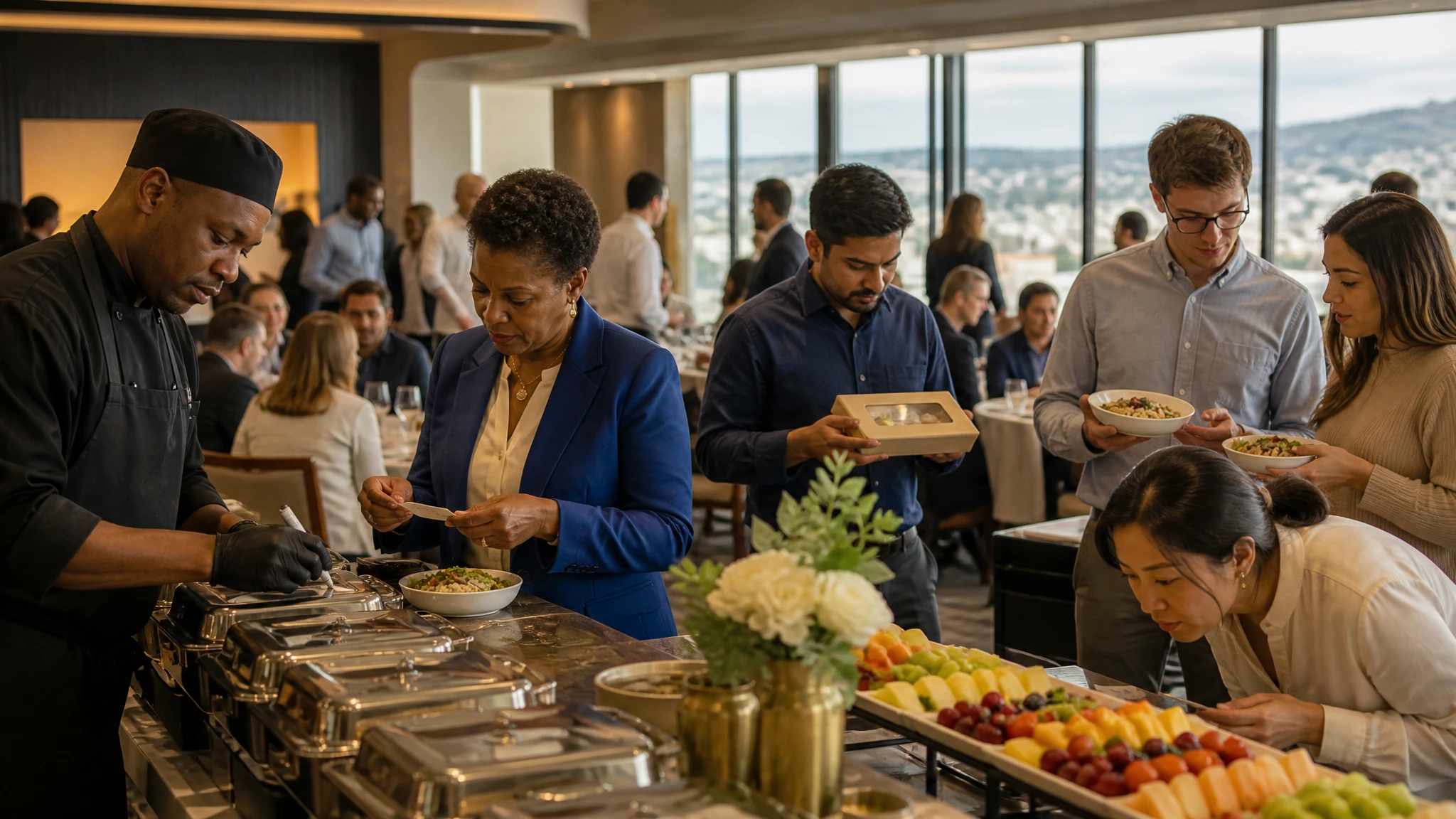
Dietary needs: plan for them from the start
Training groups are rarely uniform. Some attendees will be halal, vegetarian or vegan, and some will have allergies. Treating dietary needs as an afterthought is one of the most common ways a good day goes wrong.
Caterman accommodates halal, vegetarian and vegan requirements, as well as common allergies. To make that work smoothly, the information has to reach the kitchen in good time. Here is a straightforward approach.
- Ask at registration. Add a clear dietary question to the sign-up form, with room for free text, so people can describe their needs in their own words.
- Separate preference from medical need. A dislike and an allergy are different things. Make sure your caterer knows which is which, so the kitchen can take proper care where it matters.
- Send the details early. Pass on the full list, including numbers for each requirement, as soon as it is reasonably settled.
- Plan for late changes. People’s circumstances change. Agree in advance how last-minute updates will be handled.
- Make food easy to identify on the day. Clear labelling in the service area helps attendees choose confidently without having to ask staff each time.
We have not drawn on any official allergen or food-handling guidance for this article, so we do not make regulatory claims here. If your organisation has its own policies on allergens or dietary provision, share them with your caterer at the start.
Food prepared with care, and planned to reduce waste
Where food comes from matters to many organisers. At Caterman, more than 80% of what we serve is prepared from scratch in our San Jose kitchen. We have been serving the San Francisco Bay Area since 1997, offering full-service catering and event planning across San Jose, San Francisco and the wider region.
Training days also create a particular waste risk. Attendance can shift between registration and the morning itself, and a group that is split between sessions may eat at different times. Over-ordering is the easy response, but it produces surplus food. We plan thoughtfully to reduce food waste, and you can help by doing three things:
- Give your caterer a realistic headcount, and update it if numbers change.
- Tell us about any sessions that overlap or run in parallel, so service can match who is actually in the building.
- Be honest about whether attendees are likely to eat on arrival, at breaks, or only at lunch.
A moderate lunch also fits neatly with the waste point. If portions are sensible, fewer plates come back half full.
Practical details that make the day run smoothly
Beyond the menu, a handful of logistics decide whether catering feels seamless or disruptive.
Timing and flexibility
Build a little give into the schedule. Sessions overrun, and a lunch that is ready at a fixed minute can wait if the programme slips. Tell your caterer how much flexibility there is, and who on your side makes the call if the timetable changes during the day.
Venue access and setup
Share what you know about the venue: where service can be set up, how food will reach the space, and whether there is a separate area for breaks. Knowing these details early lets the planning reflect the real conditions instead of an assumption.
Drinks
Water, tea and coffee are a standard part of all day meeting catering. Make sure they are available throughout, not only at break times, so people can top up without leaving the room. We do not claim any particular drink improves performance, because we have no source for that. Easy access simply makes the day more comfortable.
Who is the point of contact?
Name one person on your side to coordinate with the caterer on the day. Having a single point of contact avoids conflicting instructions and makes it easier to adjust if something changes.
Questions to settle before the menu is fixed
Before you finalise workshop catering, it helps to have answers to the following. You do not need all of them perfectly, but the more you know, the better the plan.
- How many people will attend, and how firm is that number?
- What is the schedule, including the length of lunch and any breaks?
- Will the whole group eat at once, or in waves?
- What dietary requirements and allergies have been declared?
- Where will food be served, and can it be set up away from the session space?
- Is the audience mixed, or are there specific cultural or religious considerations to respect?
- Does the day end with a reception or informal gathering?
Walking through these questions with your caterer is usually more productive than choosing from a fixed list of options, because the right answer depends on the group and the programme.
What catering cannot do
It is worth being plain about the limits. Catering cannot make a dull session engaging, repair a poorly paced agenda or override a room full of people who slept badly. The sources we have point to biology, workload and meal size as factors, and only one of those is within a caterer’s control.
What a caterer can do is remove friction. Food arrives when expected. Dietary needs are respected. Portions suit the occasion. Service does not interrupt the learning. Those are modest goals, but on a full day of training they make a real difference to how the day feels.
A note on the evidence
We have kept the claims in this article deliberately narrow. The sources cited cover meal size, timing and the biology of the afternoon dip, and they come with limits: one is a short public-broadcaster explainer, one is an older review chapter, and one involves schoolchildren. None of them proves that a specific menu will keep a room alert, and we do not suggest otherwise.
If you read elsewhere that a particular food or nutrient reliably prevents the slump, ask what the source is and whether it studied adults in a working setting. In our research for this article, we found no convincing basis for that kind of promise.
Frequently Asked Questions
What is the best catering for a full day of training?
The best approach is a moderate lunch, lighter afternoon options, simple drinks and snacks at breaks, and clear handling of dietary needs. Timing and service style matter as much as the menu, so plan them together with your caterer.
Can food prevent the afternoon slump in a workshop?
Not reliably. The slump is partly biological, and the evidence on which foods help is mixed. A very large lunch may exaggerate the dip, so moderate portions are sensible, but no menu will remove it.
Should we serve a light lunch or skip it altogether?
A real lunch break is worth keeping. The research we found does not show that skipping or shrinking lunch fixes the dip. A moderate, well-timed meal, followed by an interactive session, is a more practical plan.
How do we handle dietary requirements at a training day?
Ask at registration, separate allergies from preferences, and pass the full list to your caterer early. Caterman accommodates halal, vegetarian and vegan needs as well as common allergies, and early information helps the kitchen prepare properly.