
The short answer: Industrial catering is food service built for factories, warehouses and production sites, where a whole shift eats in a short window and the food has to arrive labeled, held at the right temperature and ready to serve at your dock. Industrial catering companies plan around your shift clock instead of an office lunch hour, so meals can land at midday, mid-shift, or in the early morning or overnight. To choose one, compare how each handles timing, allergen labeling, site access and temperature control, then test it with a single shift.
Key Takeaways
- Industrial catering delivers labeled meals to a factory or warehouse on a schedule built around shift windows, not around a lunch hour.
- Plan each meal around break length, headcount for that shift and where the food is received, then add allergen labels and a clear serve point.
- Ask every caterer about permits, insurance, allergen process and temperature logging before you compare menus.
- Run one shift as a pilot before you sign a contract, so you learn how the logistics work on your actual floor.
What are industrial catering services and how do shift meals work?
Industrial catering services deliver prepared meals to a production or warehouse site on a schedule tied to your shifts. The caterer cooks off site, packs and labels the food, delivers it to an agreed point such as your loading dock, and sets up a serve window. Workers eat during their break, so timing, speed and clear labels matter more than presentation.
That definition is our own working description, not an industry standard. In practice, shift meals tend to fall into three windows, and many sites use more than one.
- Midday meals. The familiar lunch for a day shift. The whole crew breaks at about the same time, so this is the window where serve speed matters most.
- Mid-shift meals. A lighter hot item or handheld meal between the start of the shift and the main break. Sites use these for crews that start early, run long days or work through peak production periods.
- Early-morning and overnight meals. Breakfast before a first shift, or a meal in the middle of the night for a third shift. These crews often have the fewest food options nearby, so a planned meal can fill a real gap.
How shift meals differ from office catering
If you have ordered office catering before, you know the basics. A plant or warehouse changes several of them, and it helps to plan for each change on purpose.
- One-wave headcount. Office guests drift in over twenty minutes. A production crew often breaks together, so everyone reaches the serve point at once. The setup has to move a full crew through quickly.
- Short breaks. The break clock starts when the break starts, not when the caterer is ready. California has meal and rest period rules that bear on how long breaks last, so confirm your break lengths with HR or counsel before you set serve windows.
- Standing meals. Many people eat on their feet, in a break room with limited seating, or near the dock. Food should travel in sturdy containers and be easy to eat without a full table.
- Heavier appetites. People who are on their feet and moving for hours often want a fuller plate than an office group does. Plan the protein, starch and vegetable balance with that in mind, and ask your crews what they actually eat.
How a caterer compares with food trucks, vending and a staff cafeteria
Each option solves a different problem, and many sites combine them. A food truck can add variety and a break from routine, but it serves one line at a time, and its speed depends on its menu and crew. Trucks operate under a mobile food facility permit, which Santa Clara County explains on its page for food truck, cart and other mobile food facility permits. Check that page and your local rules, and confirm your site allows trucks to park and operate.
Vending is always available, which helps on overnight shifts, but it generally covers snacks and packaged items rather than a hot meal. A staff cafeteria gives you the most control over menu and schedule, but it asks you to provide space, equipment, staff and daily operation. A caterer sits between these: you get a cooked meal and a scheduled service without running a kitchen on your site. Our corporate catering work follows that model, and it can sit alongside a cafeteria for busy days or an added shift.
How do you plan shift meals around short breaks?
Start with the break, not the menu. Work out how long each shift’s meal break lasts, how many people eat in that window, and how long it takes to move them past a serve point. Then set delivery early enough for the food to be received, staged and held at the right temperature before the first person arrives.
Here is an illustrative example. It is not a real client, and every time below is a placeholder to show the logic. Imagine a three-shift site with a first shift starting at 6:00 a.m., a second shift starting at 2:30 p.m. and a third shift starting at 11:00 p.m.
- 5:00 a.m. Caterer arrives at the dock, signs in and completes badge-in. Breakfast is staged at the serve point.
- 5:30 a.m. to 6:00 a.m. Breakfast serve window for first shift as they arrive, before the line starts.
- 10:45 a.m. Lunch delivery arrives, is checked in at the dock and is moved to the break room or dock-side serve point.
- 11:15 a.m. to 12:15 p.m. Lunch serve window, split into two staggered groups so the line does not stop all at once.
- 12:30 p.m. Caterer collects serving equipment and clears the area. Compostable service ware goes to the site’s sorting stations.
- 5:15 p.m. Dinner delivery for second shift, checked in and staged.
- 5:45 p.m. to 6:30 p.m. Dinner serve window.
- 1:45 a.m. Overnight delivery for third shift, with a named contact at the site to receive it.
- 2:15 a.m. to 3:00 a.m. Overnight serve window, then cleanup.
A few habits make a schedule like this work. Agree on a headcount for each shift and a cutoff for changes, since absences, overtime and shift swaps move the numbers. Name a receiving contact for every window, including overnight, so the food is never waiting on a dock with no one to accept it. Decide whether the crew will serve themselves or whether the caterer’s staff will serve, because that choice changes how fast a one-wave crew moves. Finally, build in a buffer between delivery and serve time. If the caterer is stuck at a gate or a dock is busy, that buffer protects the break.
Traffic belongs in the plan too. Delivery from San Jose to a site in San Francisco or across the Bay Area can run differently at 5:00 a.m. than at 11:00 a.m., so talk through your site’s access times and routes when you request a quote.
What menu and site setup work for a plant floor?
A plant-floor menu should hold well, travel well and be easy to eat standing up. Think hot entrees with a starch and vegetable, grain bowls, wraps, sandwiches and soups in sealed containers, each labeled for allergens. At Caterman, more than 80% of what we serve is prepared from scratch in our San Jose kitchen, and the menu shows what we cook.
Dietary needs matter more when a whole shift eats the same service. We accommodate halal, vegetarian, vegan and common allergy needs, and it helps to know the rough mix on each shift before you choose dishes. Keep the core menu short, make sure at least one option works for each major dietary group, and rotate it so crews do not get tired of the same meal.
Allergen labeling
Label every dish so a person can read it quickly in a crowded break room. The FDA explains the basics of reading a food label for allergens, and the nine major allergens now include sesame, as the School Nutrition Association’s overview of the big nine major allergens describes. A label is information, not a promise that cross-contact cannot happen, so ask how the caterer handles it and let people with allergies speak with someone before they eat.
Site logistics
Most delivery problems at industrial sites are logistics, not food. Walk through these before the first service.
- Loading dock. Confirm which dock the caterer uses, its hours, how deliveries are scheduled around inbound freight, and where the food goes after it is received.
- Badge-in. Decide who badges in the caterer’s staff, how early they can enter, and whether they need an escort. Overnight is where this often goes wrong.
- Power. If the caterer needs outlets for warming equipment, identify the circuits and the location. Do not assume the break room has capacity.
- Handwashing. Make sure there is a handwashing sink within reach of the serve area, and check your own site’s rules about eating areas on the floor.
- Compostable service ware. Compostable plates, utensils and containers cut waste only if your hauler accepts them and your crews know which bin to use. Confirm what your hauler accepts before you order.
We also plan thoughtfully to reduce food waste. Firm headcounts help most, since overordering is the usual cause of leftovers.
What should you ask industrial caterers about safety and compliance?
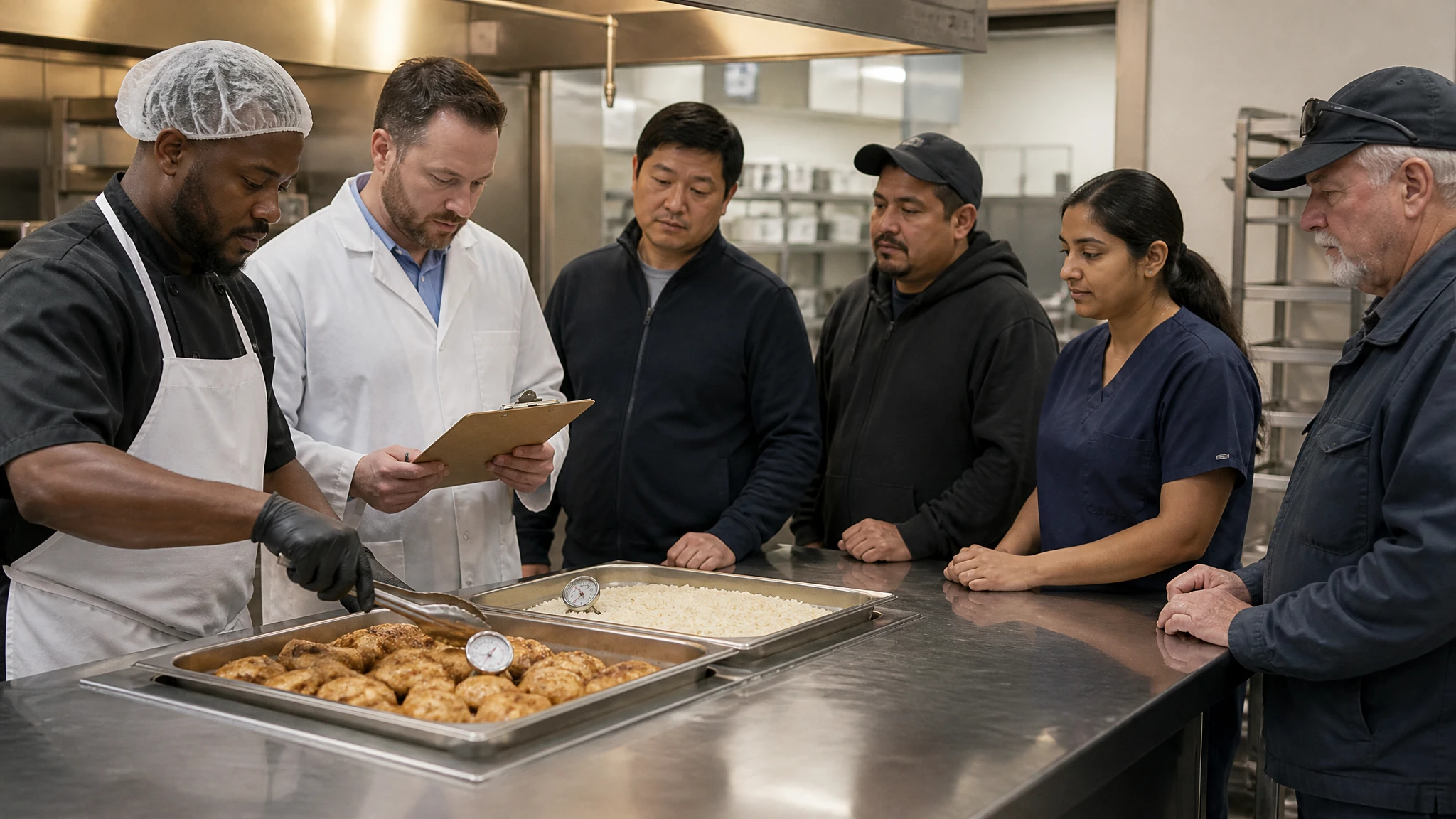
Ask industrial caterers for their permit, proof of insurance, a written allergen process and a description of how they log food temperatures. These four answers tell you whether a caterer runs a controlled operation. Request documents, not verbal assurances, and keep copies with your site’s vendor records.
- Permits. Ask which permit covers the caterer’s work and for a copy. Santa Clara County describes the process on its page to apply for a catering permit, and its retail food operations compliance page gives wider context. The state rules sit in the California Retail Food Code effective January 1, 2024. Bay Area counties have their own environmental health agencies, so confirm which one covers your site.
- Insurance. Ask for a certificate of insurance, and check it against your own site’s vendor requirements. Your legal or risk team decides the coverage you need.
- Allergen process. Ask how the caterer identifies allergens in each dish, how it labels them, how it separates ingredients during prep and transport, and who on the delivery team can answer questions at the serve point.
- Temperature logging. The range between 41°F and 135°F is widely called the food danger zone, as explained in this overview of the FDA Food Code danger zone. Ask how the caterer keeps cold food cold and hot food hot during transport and the hold time before serving, and whether it records temperatures at delivery.
Put your own questions in writing as well. Ask what happens if a delivery is late, if a dish is missing, or if food arrives outside its temperature range. A caterer with a clear answer to each has usually thought about your situation already.
What drives cost, and should you pilot one shift first?
Cost depends on a handful of factors, and a one-shift pilot is the cleanest way to see them in practice. Run one meal for one shift before you sign anything. You learn how timing, labeling, logistics and food quality work on your floor, and you learn them before a contract commits your site.
These factors shape the price of a plan, and a caterer should be able to explain how each applies to yours.
- Headcount and how firm it is. A steady, confirmed number is easier to plan than one that moves.
- Number of shifts and serve windows each week. More windows mean more delivery runs and more staffing.
- Menu. Hot entrees and made-from-scratch dishes take different prep than packaged cold meals.
- Delivery timing and distance. Early-morning and overnight service, and longer drives across the Bay Area, affect staffing and routing.
- Service style. Drop-off, a serve line with staff and cleanup afterward each need different labor.
- Dietary and allergen handling. More separate options for halal, vegetarian, vegan and allergy needs mean more planning.
- Service ware. Compostable plates and utensils are a line item, and so is pickup of used equipment.
Here is a simple way to run the pilot.
- Pick one shift and one meal window, ideally a typical day, not a holiday or a plant shutdown.
- Agree on the menu, the headcount, the dock, the receiving contact and the serve point in writing.
- Confirm the permit, insurance certificate and allergen labeling before the day.
- On the day, note arrival time, serve time, how long the line took, the temperature at delivery and how much food was left.
- Ask the crew for short, specific feedback on portions, flavor, and whether they had enough time to eat.
- Meet afterward, adjust the plan, and decide whether to expand to more shifts or a recurring schedule.
Planning Your Shift Meals
If your site is in San Jose, San Francisco or elsewhere in the Bay Area, send us your shift windows and site details through our corporate catering page and request a quote, and browse the menu to see what we cook.
Frequently Asked Questions
How is industrial catering different from office catering?
Industrial catering is planned around shift windows, a crew that breaks at the same time, short meal periods, standing meals and heavier appetites. Office catering usually serves a staggered group at a table. That means shift meals need faster serve points, sturdier packaging, clear allergen labels and a named person to receive the food at your dock.
What should we include when we ask industrial caterers for a quote?
Share your shift start and end times, the meal windows you want covered, headcount for each shift and how firm it is, dietary and allergen needs, where the food will be received, badge-in and dock details, and your service ware preferences. Mention that you want a one-shift pilot first if you are comparing options.
How do shift meals handle allergens and dietary needs?
Each dish should be labeled for the major allergens, and the caterer should be able to explain how it separates ingredients during prep and transport. We accommodate halal, vegetarian, vegan and common allergy needs. Labels are information and not a promise against cross-contact, so people with allergies should be able to ask a person before they eat.