
The short answer: A good new years day brunch menu mixes a few hot dishes, a few chilled ones, something sweet and a drink option, all sized so the food can be served in stages. A catered brunch at home is a buffet, so keep hot food at 140°F or above, keep cold food at 40°F or below, and refill in small batches. Caterman can plan and serve it for you in San Jose, San Francisco and across the Bay Area.
Key Takeaways
- Build the menu around a few hot dishes, a few chilled ones, something sweet and a drink station, then plan around any dietary needs your guests have.
- A catered brunch at home is a buffet, so USDA time and temperature guidance applies: hot at 140°F or above, cold at 40°F or below, and no more than two hours at room temperature.
- Several small platters, refilled from the oven or refrigerator, work better than one large dish sitting out.
- Cost depends on guest count, service style, staffing, rentals, menu complexity and holiday timing.
What Goes on a New Years Day Brunch Menu?
A new years day brunch menu usually works best as a balanced spread: a couple of hot main dishes, a few sides, something fresh and chilled, baked goods or something sweet, and coffee, juice or a bar. Start with how long your guests will stay and whether they will sit down to eat or graze through the morning. Then fit the dishes to that plan.
Think in categories first and specific dishes second. Hot dishes should be ones that hold well in a chafing dish or warming tray. Chilled dishes should be ones that sit comfortably on ice. A little contrast helps too, so the table has something rich, something light, something savory and something sweet. People often arrive tired after the night before, so a menu that feels easy to eat and easy to return to tends to suit the day. More than 80% of what we serve is prepared from scratch in our San Jose kitchen, which means we can talk through what travels and holds well before we settle on a menu. If any guests eat halal, vegetarian or vegan, or have common allergies, tell us early so the menu can be built around those needs from the start. You can look through the menu for a sense of what we cook.
What Are Some New Years Day Brunch Ideas for Hosting at Home?
The most useful new years day brunch ideas are about format, not just food. You can choose a buffet, a set of serving stations, or staffed service with a bartender, and you can let guests arrive over a window of time instead of all at once. Pick the format first, then build the dishes around it.
A buffet is the simplest format and the one most people picture. Stations split the table into smaller areas, such as a hot dish area, a cold area and a drink area, which keeps lines short in a home where space is tight. That matters whether you live in a house in San Jose or an apartment in San Francisco. Staffed service adds people who replace dishes, clear plates and keep an eye on the clock, which is helpful when you would rather talk with your guests than tend a table. For drinks, we provide bartenders and full bar setup, but we do not sell or supply alcohol. You supply it and we serve it. Coffee, tea, juice and other nonalcoholic drinks belong on the same table so everyone has something to pour. For more on how we handle gatherings like this, see our page on private events.
How Do You Serve a Catered Brunch Safely at Home?
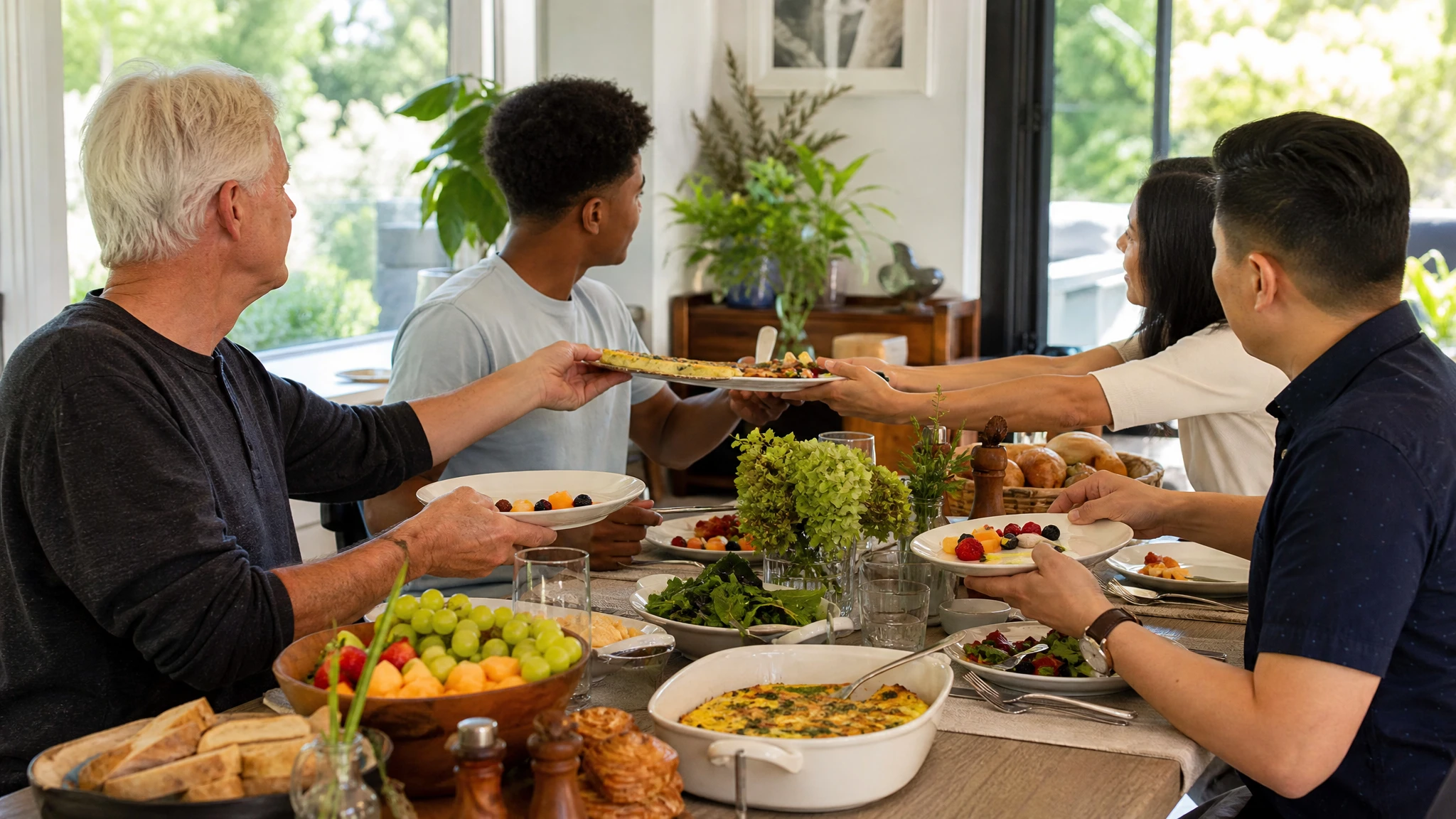
Treat it like any buffet. USDA says bacteria grow rapidly between 40°F and 140°F, so keep hot food at 140°F or above and cold food at 40°F or below. Use chafing dishes, warming trays or slow cookers for hot dishes, set chilled dishes in ice, and keep the rest of the food in the oven or refrigerator until it is needed.
The reason for all that care is speed. USDA notes that bacteria in the danger zone can double in number every 20 minutes. Hot-holding equipment keeps hot food hot, but it is not meant to reheat cold food. USDA says to reheat food to at least 165°F before it goes into the warming equipment. USDA FSIS also lists chafing dishes, slow cookers and warming trays for keeping buffet food hot. For cold dishes, FSIS suggests nesting serving dishes in bowls of ice and using small serving trays that you replace often. If you are holding food in your own oven while the buffet runs, Utah State University Extension, quoting the USDA Meat and Poultry Hotline, gives an oven setting of 200 to 250°F. These steps lower risk but do not remove it, so keep watching the table.
How Long Can Brunch Food Sit Out?
Perishable food should not sit at room temperature for more than two hours, according to USDA guidance for party hosts. Track how long each dish has been on the table and discard anything that has been out longer. USDA names meat, poultry, eggs and casseroles among the perishables that should not stay in the danger zone over two hours.
That list matters for brunch, because eggs and casseroles are common on a brunch table. USDA makes the same point in its advice on holiday party food poisoning. The practical answer is to put food out on several small platters instead of one large one, and to keep the rest hot in the oven or cold in the refrigerator. Mississippi State University Extension notes that small dishes can be finished and replaced within two hours, and that this helps prevent cross-contamination from food that has already been in the danger zone. Leftovers follow a similar clock. FSIS says to refrigerate them within 2 hours of cooking or of taking the food out of a warming appliance. The limit drops to 1 hour when the temperature is above 90°F, which is worth remembering if the buffet sits near a sunny window or a warm room. On a long holiday morning, guests tend to linger, so someone needs to be watching the clock. With staffed service, that job is built in.
What Affects the Cost of a Catered Brunch?
Cost depends on a handful of choices rather than one number. The main factors are how many guests you invite, whether you want drop-off, buffet or staffed service, how many staff the event needs, what rentals and equipment the setup calls for, how complex the menu is, and the timing on a holiday. We can walk through each one with you after you send the details.
Guest count affects how much food is prepared and how many platters are needed. Service style changes how much of the work we take on, from delivering food that you set out yourself to staff who set up, refill and clear. Staffing grows with the size of the group and with extras like a bartender. Rentals and equipment come into play because the safety steps above rely on real tools, such as chafing dishes for hot food and containers for ice. A menu with many separate dishes, or dishes that need careful finishing, takes more planning and more hands than a simpler one. Holiday timing also matters, since January 1 is a day when many people and vendors are off. Bring those details to us as early as you can, and we will explain what each choice means for your plan. You can see how we approach events in general on our events page.
Planning Your Event
If you are hosting a brunch at home in San Jose, San Francisco or elsewhere in the Bay Area, we would be glad to help you shape the menu and the service around your space and your guests. You can request a quote or look at the menu to start the conversation.
Frequently Asked Questions
Can Caterman supply the alcohol for a New Year’s Day brunch?
No. We provide bartenders and a full bar setup, but we do not sell or supply alcohol. You supply it and we serve it. We can also help you plan nonalcoholic drinks such as coffee, tea and juice so every guest has something to pour.
How do I keep catered brunch food hot at home?
Use chafing dishes, warming trays or slow cookers to keep hot food at 140°F or above, and keep the rest of the food in the oven until it is needed. USDA says not to use these tools to reheat cold food, and to reheat food to at least 165°F first.
Can you accommodate dietary needs at a brunch?
Yes. We accommodate dietary needs including halal, vegetarian, vegan and common allergies. Tell us about your guests’ needs early in the planning, and we will build the menu with those needs in mind.