
The short answer: A good holiday cocktail party menu pairs small passed bites that servers carry through the room with a few stations that hold temperature and give guests a place to gather. Plan it around timing: what is served hot, what is served cold, and how often the kitchen replaces platters. Holiday cocktail party food works best when every item can be eaten standing up, with a glass in the other hand.
Key Takeaways
- Use passed bites for the first part of the evening and stations as guests settle in, so there is always something to eat and somewhere to gather.
- Perishable food should not sit at room temperature for more than 2 hours, so a catered menu relies on small platters replaced on a schedule.
- Hot items stay at 140°F or above and cold items at 40°F or below, which helps decide what is passed and what goes on a station.
- Cost follows the number of hot and cold items, the equipment they need, and the staff needed to keep service on time.
What Belongs on a Holiday Cocktail Party Menu?
A holiday cocktail party menu usually has three parts: passed bites that arrive early and keep arriving, two or three stations that anchor the room, and something small and sweet near the end. Everything should be easy to eat in one or two bites, without a table, a knife or a seat. Add a drink program and dietary options, and the evening is covered.
Here is how those parts usually fit together:
- Passed bites. Small, freshly plated items that servers carry on trays. They suit the first hour, when guests arrive, find a drink and start talking.
- Stations. Fixed tables or counters, hot or cold, where guests help themselves or a server plates for them. They give the room a center and a little more choice.
- Something sweet. Small desserts passed or set out late in the evening. If you want a cake, you bring it from your own baker and we handle the cutting and plating.
- A drink program. Bartenders and a full bar setup, which we cover in its own section below.
Holiday appetizers catering is mostly a question of rhythm. A cocktail party has no seated courses to mark the hours, so the menu has to do that work. Guests should see something new come out of the kitchen every so often, and nothing should sit so long that it loses its flavor or its texture. More than 80% of what we serve is prepared from scratch in our San Jose kitchen, which lets us time that work to your schedule instead of relying on items that were made far ahead. You can look over the menu to see how we think about food, and our private events page explains how we plan a party from the first conversation to the last tray.
How Do Passed Bites and Stations Work Together?
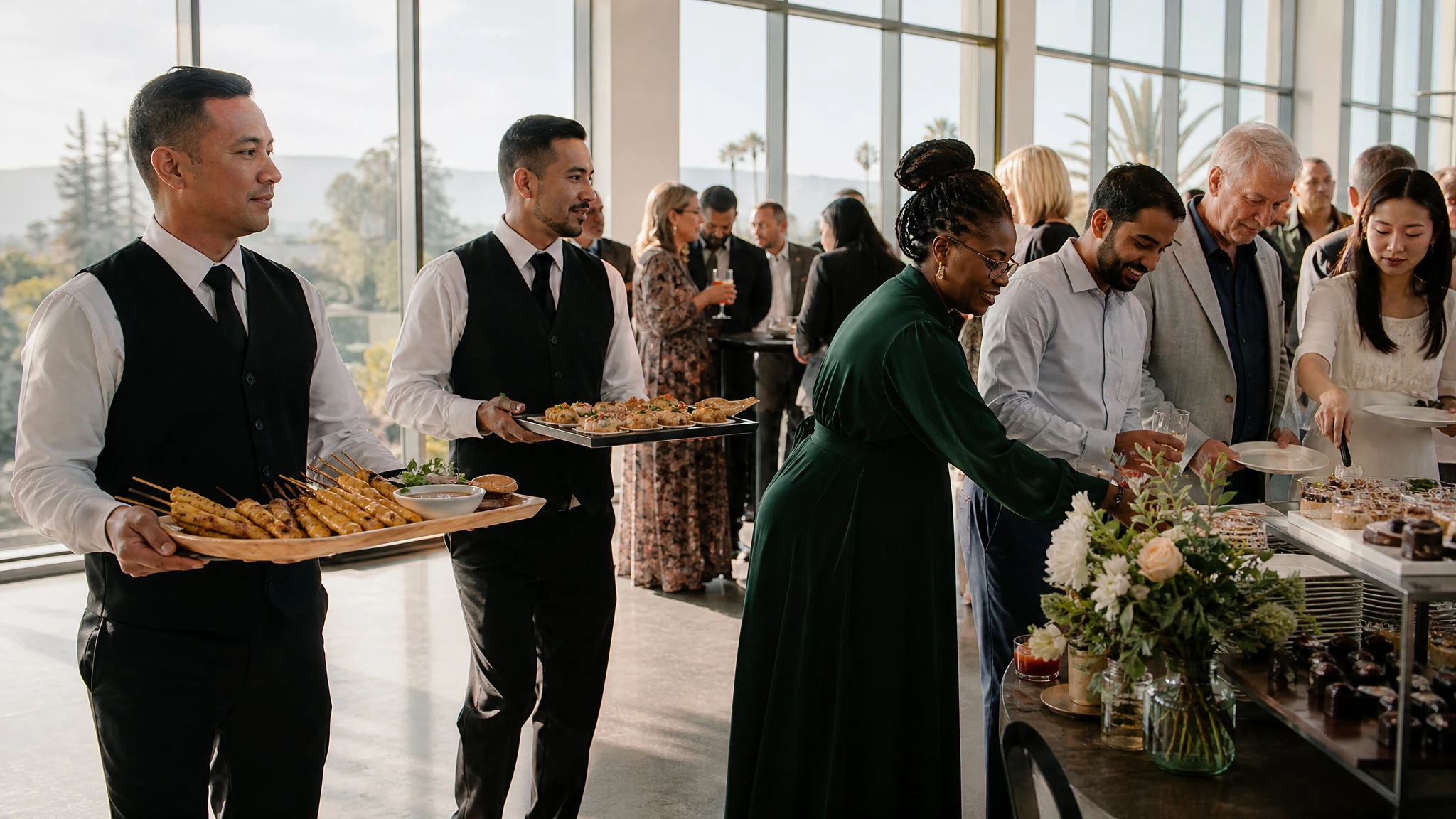
Passed bites keep the room moving and reach guests who are deep in conversation. Stations give people a place to gather and a little more food to choose from. Passed bites carry the first part of the evening, and stations take over as guests settle in, so no one waits for food and no platter sits out too long.
A passed bite is a small portion plated fresh and carried out by a server. Because each tray holds a limited amount, it is replaced often, which suits food that tastes best soon after it is made. Good passed bites are eaten in one or two bites, need no fork and do not drip. Think of warm pastries, small skewers, chilled spoons or crostini. Mixing hot and cold items lets servers rotate trays, and it keeps the kitchen from asking one oven to do everything at once.
A station is a place for equipment that holds temperature. A hot station may use chafing dishes with a heat source under them. A cold station may nest serving dishes in bowls of ice. Stations suit food that guests want to choose for themselves, such as a sliced main with small rolls, a grazing table of cheeses, fruit and cured items, or a warm dip with something to scoop it. They also give a long room a visual center, which helps people spread out instead of crowding one corner.
A simple way to decide between the two:
- Choose a passed bite when the item is best eaten right away, is small and neat, and works well on a tray.
- Choose a station when the item needs equipment to hold its temperature, when guests will want to pick their own portion, or when you want a gathering point.
- Use both when your guest list is large, your space has more than one room, or the party runs several hours.
The same plan works for different kinds of gatherings. A family open house in San Jose may lean toward warm passed bites and one generous station. A company party in San Francisco may use stations in several spots so a crowd does not line up in one place, and our corporate events page covers how we handle those. In both cases, we start with your venue, your guest count and your schedule, and then decide how many servers and stations the evening needs.
How Do Caterers Keep Holiday Appetizers at the Right Temperature?
Caterers work from a few simple rules. Hot food stays at 140°F or above, cold perishable food stays at 40°F or below, and perishable food does not sit at room temperature for more than 2 hours. Small platters are swapped out on a schedule, so what guests see is always fresh and always held at the right temperature.
These numbers come from federal guidance, and they shape how a holiday cocktail party menu is built. The USDA says perishable food should not sit at room temperature for more than 2 hours, and food left out longer should be discarded. The USDA Food Safety and Inspection Service (FSIS) adds, in its Kitchen Companion handbook, that the limit drops to 1 hour when the temperature is above 90°F. On a Bay Area winter evening, the 1 hour limit matters less. It can come into play in a warm indoor room or an outdoor setup near heaters, which is one reason we ask about your space early.
The same guidance gives practical habits that a caterer builds into the evening:
- Hot stations. Hot food on a buffet should stay at 140°F or above. Chafing dishes, warming trays and slow cookers keep food hot. They are not meant to reheat cold food, so items are brought up to at least 165°F before they go out, as the USDA party food guidance advises.
- The Danger Zone. Bacteria grow rapidly between 40°F and 140°F. FSIS calls this range the “Danger Zone” in its leftovers and food safety guidance, and it is the reason cold and hot items are held at the ends of that range.
- Cold stations. Cold perishable food, such as a platter of deli meats, should be kept at 40°F or below. Nesting serving dishes in bowls of ice helps, and so does using small serving trays that are replaced often.
- Small platters. Serve food on several small platters instead of one large one. Keep the rest hot in an oven set at 200 to 250°F, or cold in the refrigerator, until it is time to serve. The USDA Meat and Poultry Hotline handout on holiday or party buffets also says to replace an empty platter rather than topping up a dish that still has food in it. Utah State University Extension reproduces the same handout.
- Clean hands and plates. The handout says to wash hands before and after handling food and to serve food on clean plates.
- Transport. Carry hot food in an insulated container, and carry cold food in a cooler with ice or commercial freezing gel.
This is why a catered evening is built around timed service. The kitchen holds the backup supply, servers bring out fresh platters in rounds, and chafers and ice do the work of holding temperature between rounds. Leftovers follow the same clock. FSIS says to refrigerate them within 2 hours of cooking, or within 2 hours of the food coming off an appliance that kept it warm. Serving in smaller rounds also fits with how we plan thoughtfully to reduce food waste. These sources are national guidance, so your venue or county may have its own requirements, and it is worth confirming them before the party.
How Do You Plan Dietary Needs, the Bar and Dessert?
Tell your caterer about dietary needs early, then build them into the menu instead of adding them at the end. We accommodate halal, vegetarian and vegan guests as well as common allergies. For drinks, we provide bartenders and a full bar setup, and you supply the alcohol. For dessert, you bring your own baker’s cake and we serve it.
On a cocktail menu, dietary options work best when they sit among the other items, not on a separate plate that signals who is different. A vegetarian passed bite, a vegan station item and a halal option can all be part of the same evening. Allergies need more care. Let us know which allergies are on your guest list, and we will talk through how each dish is prepared and how to label it. We cannot promise that any food is free of an allergen, so guests with serious allergies should always be able to ask a team member about a specific dish.
The drink side of a cocktail party is a service question as much as a supply question. We bring the bartenders and the full bar setup, and we serve what you provide, but we do not sell or supply alcohol. Plan your drink list with the food in mind, because a menu of rich, warm bites asks for different drinks than a menu of light, cold ones. For dessert, we do not bake or supply the cake. If you have a cake from your own baker, we provide cake service, which means cutting and plating it so guests can take a piece and keep mingling. Also ask your venue early about its own rules, such as open flame for chafing dishes, alcohol service and any caterer requirements. Those vary by venue, and they can change how stations are set up.
What Drives the Cost of Holiday Appetizers Catering?
The cost of a holiday cocktail party menu follows the work behind it. The main factors are how many hot items and how many cold items you choose, the equipment those items need to hold temperature, and the number of staff needed to replace platters on time. Guest count, event length and venue access matter too.
Here is how those factors play out:
- Hot versus cold items. Hot items need ovens, chafers and heat sources, and they are served in rounds. Cold items need refrigeration, ice and cold holding. A menu weighted toward one side asks for different equipment than a balanced menu.
- Passed bites versus stations. Passed bites need more servers and more hand plating. Stations need more equipment and more table space. A mix of the two spreads that work across the evening.
- Staffing for timed replenishment. Replacing small platters on a schedule, instead of leaving one large dish out, takes people in the kitchen and in the room.
- Preparation from scratch. Making most of the food in our San Jose kitchen takes planning and kitchen time, and that time is part of the work behind the menu.
- Venue and logistics. Loading access, kitchen space at the venue, travel across the Bay Area and the length of the event all shape the plan.
If you want to adjust the plan, you have several levers. A shorter event window, fewer hot items, or one strong station in place of three smaller ones can change the staffing and equipment needs without making the party feel thin. We would rather talk through those trade-offs with you than hand you a standard package. Tell us what matters most about the evening, and we will suggest where to spend effort and where to simplify.
Planning Your Event
If you are planning a holiday party in San Jose, San Francisco or elsewhere in the Bay Area, we can help you shape the passed bites, stations and timing around your venue and guest list. Browse the menu for ideas, then request a quote and tell us about your date and space.
Frequently Asked Questions
How many passed bites and stations does a holiday cocktail party need?
It depends on your guest count, the length of the event, your venue and how much of the evening is meant to replace a meal. We do not use a fixed formula. A common plan is passed bites early, then a few stations as guests settle in. Share your details with us and we will build the mix with you.
Can holiday cocktail party food stay out for the whole evening?
Not if it is perishable. Perishable food should not sit at room temperature for more than 2 hours, and the limit is 1 hour above 90°F. That is why we serve on small platters, keep backup supply hot or cold in the kitchen, and replace platters on a schedule instead of leaving one dish out all night.
Does Caterman provide the alcohol and the cake for a holiday party?
No. We provide bartenders and a full bar setup, but you supply the alcohol and we serve it. We do not bake or supply the cake. If you bring a cake from your own baker, we provide cake service, which means cutting and plating it for your guests.