
The short answer: Off-premise catering for events means a caterer prepares food in an approved kitchen and serves it at a different location, such as your home, an office, or a winery. In California this is a defined and permitted activity, and most of the cooking happens before the food leaves the kitchen. Only limited finishing and service happen at the venue.
Key Takeaways
- California law treats catering as a permitted food service run from an approved permanent kitchen, with only limited preparation at the event site.
- Permits are handled at the county level, and a private event and a public community event can follow different permit paths.
- Venues such as wineries and breweries can be host facilities with their own permit requirement, so ask about the venue early.
- A good off-site plan covers food, service, bar, cake service, and dietary needs before event day, not on it.
What Is Off-Premise Catering for Events?
Off-premise catering for events is food service that a permanent, approved kitchen carries out at another location. Under the California Retail Food Code, a catering operation serves food, or does limited food preparation, at a different site as part of a contracted offsite food service event, or alongside a host facility with direct food sales. Takeout or delivery that guests serve themselves is not included.
You may also hear this called off-site catering or remote site catering services. The names differ, but the idea is the same. The kitchen stays in one place, and the event happens somewhere else, whether that is a backyard in San Jose, a loft in San Francisco, or a winery or brewery elsewhere in the Bay Area.
California treats this as a defined, permitted activity. The California Retail Food Code, known as CalCode, lists catering operations as a type of food facility. The definition is in Section 113739.1, and the edition that took effect on January 1, 2026 is the current reference. You can read the full text in the 2026 CalCode copy published by Alameda County’s Department of Environmental Health.
The definition describes a food service run by a permanent food facility that is approved for food preparation. It applies in two cases. One is a contracted offsite food service event. The other is when the operation works in conjunction with a host facility that has direct food sales. The code treats a host facility as its own defined term, which matters when your venue is a winery, a brewery, or a similar place.
Two things fall outside the definition. Food you order as takeout or delivery and serve yourself is not catering in this sense. And a cook-for-hire, meaning a person hired to prepare or serve food at a private on-site event, is not a catering operation either, according to El Dorado County’s guidance for caterers. A catering operation works from an approved permanent facility, and that shapes everything else in this article.
How Does a Caterer Run an Event Away From Its Kitchen?
A caterer runs an event away from its kitchen by doing the heavy preparation at an approved kitchen, moving the food to the venue, and finishing and serving it there. Regulators describe the work at the event itself as limited food preparation and service. That is why the planning done before event day matters more than anything that happens at the venue.
Start with the kitchen. At Caterman, more than 80% of what we serve is prepared from scratch in our San Jose kitchen. For an off-site event, that means the sauces, proteins, sides, and salads are made there, then packed for the trip. The venue is not the place to begin cooking from raw ingredients. It is the place where food that is already prepared gets its final steps, such as plating and assembling, and then reaches your guests.
This matches how public health agencies describe the work. San Luis Obispo County’s environmental health program says food service is conducted from a permitted permanent facility, and it names a shared food facility, commissary, restaurant, or retail market as examples. Only approved limited food preparation and service may happen at the event location. The county’s catering operation requirements also say catering operations must comply with the applicable sections of CalCode. That is one county’s page, but it shows the pattern clearly.
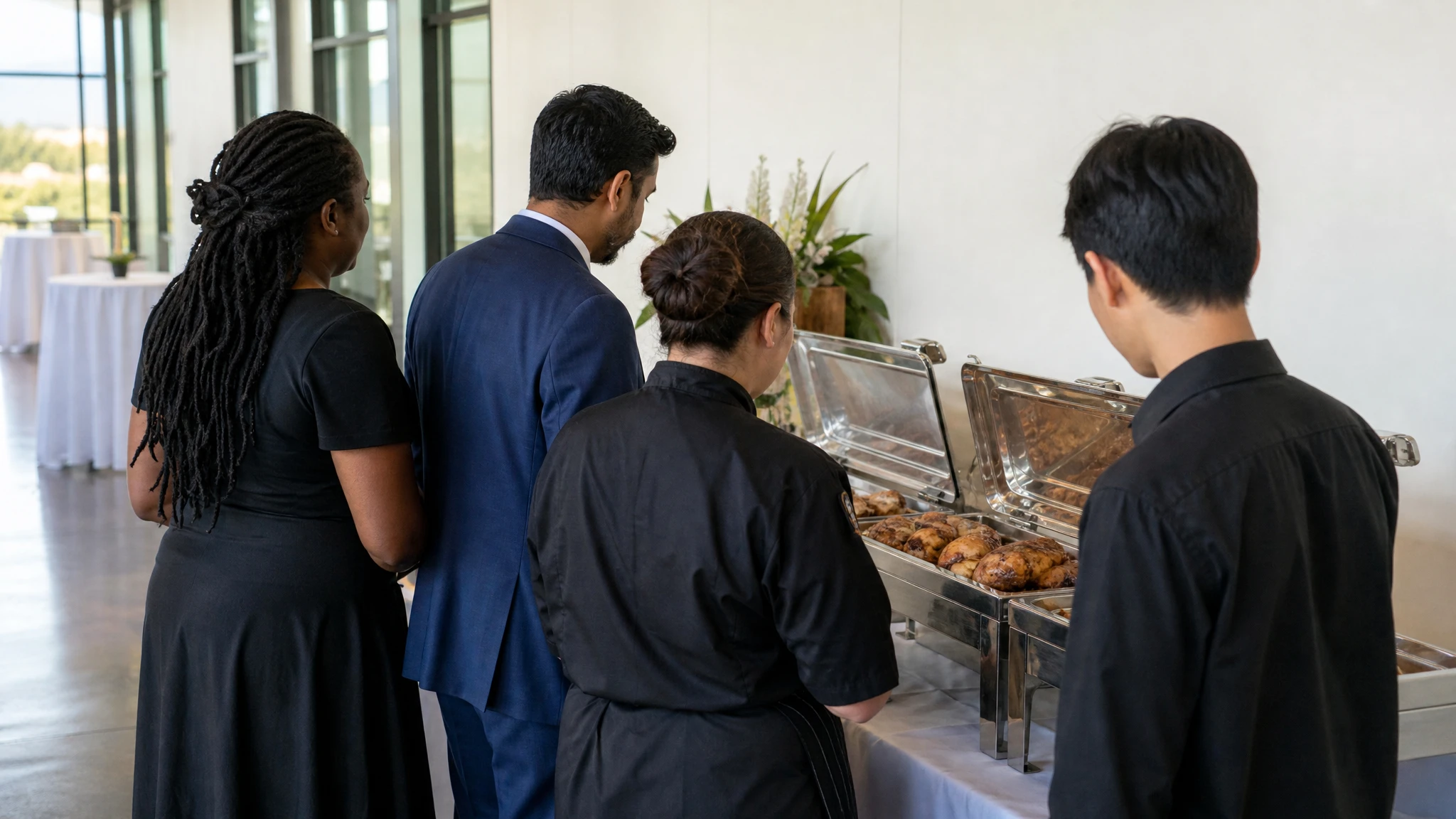
Protecting the food once it arrives is part of the job. Santa Cruz County’s catering guidance gives an example: food service at the off-site location must be protected from contamination, for instance with approved chafing dishes. In plain terms, the food at your event should be covered and held in proper serving equipment, not left open on a table. You can read that county’s catering operation requirements and permitting page for the full language.
Food is only part of the event. A full-service team also handles setup, serving, and breakdown. We provide bartenders and a full bar setup, though we do not sell or supply alcohol. You supply it, and we serve it. If you have a cake from your own baker, we provide cake service, which means cutting and plating it. We do not bake or supply the cake.
We also plan quantities thoughtfully to reduce food waste. An off-site event has no back kitchen to absorb surplus, so careful planning on the front end matters even more than it does at home base.
Which Permits Apply to Remote Site Catering Services in California?
Permits are issued at the county level, and the path depends on the event. A contracted private event is generally served under the caterer’s catering operation permit. A public community event usually calls for a Temporary Food Facility permit. If your venue is a host facility, such as a winery or brewery, its operator has a permit requirement too. Your caterer manages its own permits, but you should confirm which ones apply to your event.
Here is how one county describes the basics. Santa Cruz County’s environmental health division says a catering operator must apply for and obtain a Catering Operation permit before conducting food service. The county notes that CalCode was amended effective January 1, 2019 to add the Catering chapter, along with the terms Catering Operation and Host Facility. The Legislature made that change through AB 2524, passed in the 2017 and 2018 session. Because this is Santa Cruz County’s process, treat it as an example of how county-level permitting works, not as the rules for San Jose.
El Dorado County explains the same idea from a restaurant’s point of view. A restaurant that already holds a fixed-facility health permit needs an additional catering operations permit to cater or sell directly at a host facility. Before it caters, it must submit its catering standard operating procedures for review and approval. The county says a host facility can be a brewery, winery, commercial building, or another approved location. The practical lesson is that a kitchen’s regular permit and its catering permit are separate things.
The 2019 law added several details that help explain the rules. While operating offsite, a catering operation must give its facility name, city, state, ZIP code, and operator name to any consumer or enforcement agency on request. It may not store food, beverages, equipment, or utensils in a private home when it is not conducting offsite catering. And the person who operates a host facility must get a permit, in addition to any permit the catering operation holds. This describes the 2019 bill. The 2026 CalCode is the current text, so check it for exact wording.
Public events can fall under a different path. Both Santa Cruz and El Dorado counties say a catering operation that joins a community event, such as a farmers’ market, needs a separate Temporary Food Facility permit. Placer County’s temporary food facility FAQ shows how that line is drawn there. A permit is required for a community-event food vendor even when the food is given away. A private party generally does not need one, but an event advertised to the public does. A temporary permit can be valid for up to one year, or a vendor can get one for a single event, and each community event needs a new application and permit.
San Luis Obispo County’s temporary food facility application adds a useful point. It says its requirements are based on CalCode and that food must be prepared on-site or in an approved commercial food facility. That is another reason catered food starts in an approved kitchen.
All of these are other counties, and permit details differ from place to place. We do not summarize Santa Clara County’s requirements here. If your event is in San Jose or elsewhere in the county, confirm with the Santa Clara County Department of Environmental Health which permit applies. For an event in San Francisco or another Bay Area county, ask that county’s environmental health agency the same question.
What Should You Ask About a Venue Before Booking Off-Site Catering?
Ask the venue what it allows for outside caterers, what the space looks like for serving, and whether it counts as a host facility with its own permit. Then share those answers with your caterer early. Venues set their own rules, and a short conversation up front shapes the menu, the staffing, and the setup far more than any change made on the day.
Begin with the basics of access and layout. Where will the caterer set up, and how will food and equipment reach that spot? Where will guests eat, and where will the bar and any cake table go? Is the venue a winery, brewery, or commercial building that holds its own permit? Ask for the venue’s requirements in writing, and pass them along so your caterer can plan around them. Distance matters too. For events in San Francisco or farther around the Bay, the trip from our San Jose kitchen is part of the plan from the start.
Then connect the venue to the menu. A menu built around food that is fully prepared in the kitchen and finished simply on site fits the limited-preparation model that California describes. Tell us about dietary needs early. We accommodate halal, vegetarian, vegan, and common allergies, and the more notice we have, the more carefully we can plan each dish and how it is served. You can browse the menu to see how we think about options before you decide what your event needs.
How Does Off-Premise Catering Change by Event Type?
The kitchen work is similar, but the setting and guest expectations differ. Weddings often involve a host venue and a cake from your own baker. Corporate events work around office schedules and building access. Private parties at home depend on the space you have. In each case, the caterer plans around the site rather than asking the site to change.
For a wedding, the venue question often comes first, because many couples choose a winery, garden, or event space that is not a restaurant. Our wedding catering approach covers food, service, bar setup, and cake service, with the cake coming from your baker. Weddings are also where the host facility rules above are most likely to come up, so confirm the venue’s permit situation early.
For a company gathering, the questions are usually about timing, access, and how many people must be served within a set window. Our corporate catering page explains how we handle those events, whether they take place in San Jose, San Francisco, or elsewhere in the Bay Area.
For a milestone birthday, an anniversary, or a family celebration at home, you are the host and the venue. That makes the plan very personal. Our private events page covers these gatherings. A private party in a home is a good example of why catering is different from a cook-for-hire: the food is prepared in an approved kitchen, then served at your location by a team that handles the details.
Planning Your Event
If you are planning an event in San Jose, San Francisco, or anywhere in the Bay Area, you can request a quote and tell us about your venue, your guest count, and any dietary needs. You can also look through the menu to see what we cook from scratch in our San Jose kitchen.
Frequently Asked Questions
Is a cook-for-hire the same as a catering operation?
No. El Dorado County’s guidance says a cook-for-hire, a person hired to prepare or serve food at a private on-site event, is not a catering operation. A catering operation is run by a permanent food facility approved for food preparation, and it serves food or does limited food preparation at another location.
Does a private party need a food permit?
It depends on the county and the event. Placer County says a private party generally does not need a temporary food facility permit, but an event advertised to the public does. Your caterer still works under its own catering permit. Confirm what applies with the Santa Clara County Department of Environmental Health or your local agency.
Can a caterer prepare or store food at a private home?
Not for catering. The 2019 California law that added catering operations to the Retail Food Code says a catering operation may not store food, beverages, equipment, or utensils in a private home when it is not conducting offsite catering. Food is prepared in an approved kitchen, and only limited preparation happens at the event.