
The short answer: Wedding venues with in house catering usually require you to use their kitchen or their exclusive caterer, so you often cannot bring your own. Some venues keep an approved list, and others allow outside caterers who meet county health permitting and the venue’s own rules. The only way to know is to ask the venue, in writing, before you sign.
Key Takeaways
- Venues with in-house or exclusive catering usually require you to use their caterer. Others keep an approved list, and some allow outside caterers.
- Ask three things on your first tour: whether outside caterers are allowed, whether they must be on an approved list, and whether the venue’s kitchen can be used.
- An outside caterer needs the right local health permit. A venue’s own permit does not automatically cover a visiting caterer.
- Compare packages by a written list of what is included: menus, staffing, rentals, bar service and cake handling.
How Do Wedding Venues With In House Catering Work?
A venue with in-house catering either runs its own kitchen or names one exclusive caterer, and the food becomes part of your venue agreement. You book the space and the meal together, and you usually choose from that venue’s menus. Because each venue writes its own terms, your contract is the only place that tells you what is actually covered.
You will hear several labels as you tour venues in San Jose, San Francisco and around the Bay Area. In-house means the venue has its own kitchen and culinary team. Exclusive means one named caterer handles every event at the site. An approved or preferred list means you choose from a short roster the venue has vetted. Open means outside caterers are welcome, usually with conditions. These are working labels, not legal categories, and venues use them loosely, so a phrase like catering included can mean different things at different places. Ask the venue to describe, in plain terms, who cooks, who serves and who is responsible if something goes wrong on the day. Then read the catering section of the contract for the points that change your plans: whether the menu can be customized, how your final guest count is set, and what the venue expects from you if you want anything outside the package. The upside of an included setup is one contract and one point of contact. The tradeoff can be less flexibility on menus, which matters if you are planning around halal, vegetarian, vegan or allergy needs, or a family dish you want on the table.
Can You Bring Your Own Caterer to a Venue With In-House Catering?
Sometimes, but often not. A venue with exclusive in-house catering usually requires you to use its caterer. A venue with an approved list lets you pick only from that list. An open venue may allow an outside caterer, as long as that caterer holds the right county health permit and meets the venue’s own requirements. Find out which of the three describes your venue before you fall in love with the space.
Put the question to the venue in writing, and ask it in three parts. First, are outside caterers allowed at all? Second, if they are, must the caterer be on an approved list, and how does a caterer get on it? Third, can the venue’s own kitchen be used, or must the food be prepared elsewhere and brought in? The answers shape everything that follows, from your menu to your timeline. If you want a caterer you already trust, or a menu a venue kitchen does not offer, raise it on your first tour, not after a deposit is down. It is also fair to ask whether the venue charges any fee for outside vendors and what paperwork or insurance it expects from them. Our wedding catering page explains how we serve couples whose venues are open to outside caterers.
What Does an Outside Caterer Need to Work Legally at a California Venue?
An outside caterer needs a valid health permit and must work from a permitted kitchen. California’s retail food code now has a catering operation category and a host facility category, added effective January 1, 2019, as Chapter 10.1, Catering Operations and Host Facilities. County rules differ, so a venue’s own permit does not automatically cover a visiting caterer. Santa Cruz County’s catering operation requirements describe a catering operation as a food service run by a permanent food facility approved for food preparation. It serves food, or does limited food preparation, at a contracted offsite event. That document says only limited food preparation can happen off-site, that food service at the location must be protected from contamination, for example with approved chafing dishes, and that additional requirements may apply depending on the venue.
Other counties show how this looks in practice. Kern County Public Health’s catering guidelines say a caterer must hold a valid health permit and that, before the function, food must be stored and prepared at the caterer’s permitted food establishment or another approved food facility. They also say potentially hazardous food must be transported, prepared and held at the required temperatures, and that a caterer may not serve home-prepared food at a catered function. Kern County is not in the Bay Area, so treat it as an example of local guidance, not as your county’s rule. El Dorado County’s caterers page cites California Retail Food Code section 113739.1. It says a catering operation can use a permitted kitchen if it has a written agreement for that kitchen and a catering operation permit. A restaurant that already holds a fixed-facility health permit needs an additional catering operations permit to cater, and the county reviews the standard operating procedures before the health permit is issued. It describes a host facility as a county-approved location, such as a brewery, winery or commercial building, that operates alongside a permitted catering operation or retail food facility. San Luis Obispo County gives the same definition of a catering operation. For Santa Clara County, San Francisco and Alameda County, confirm the current rules directly with each county’s environmental health office.
How Do In-House Catering Packages Work for Weddings?
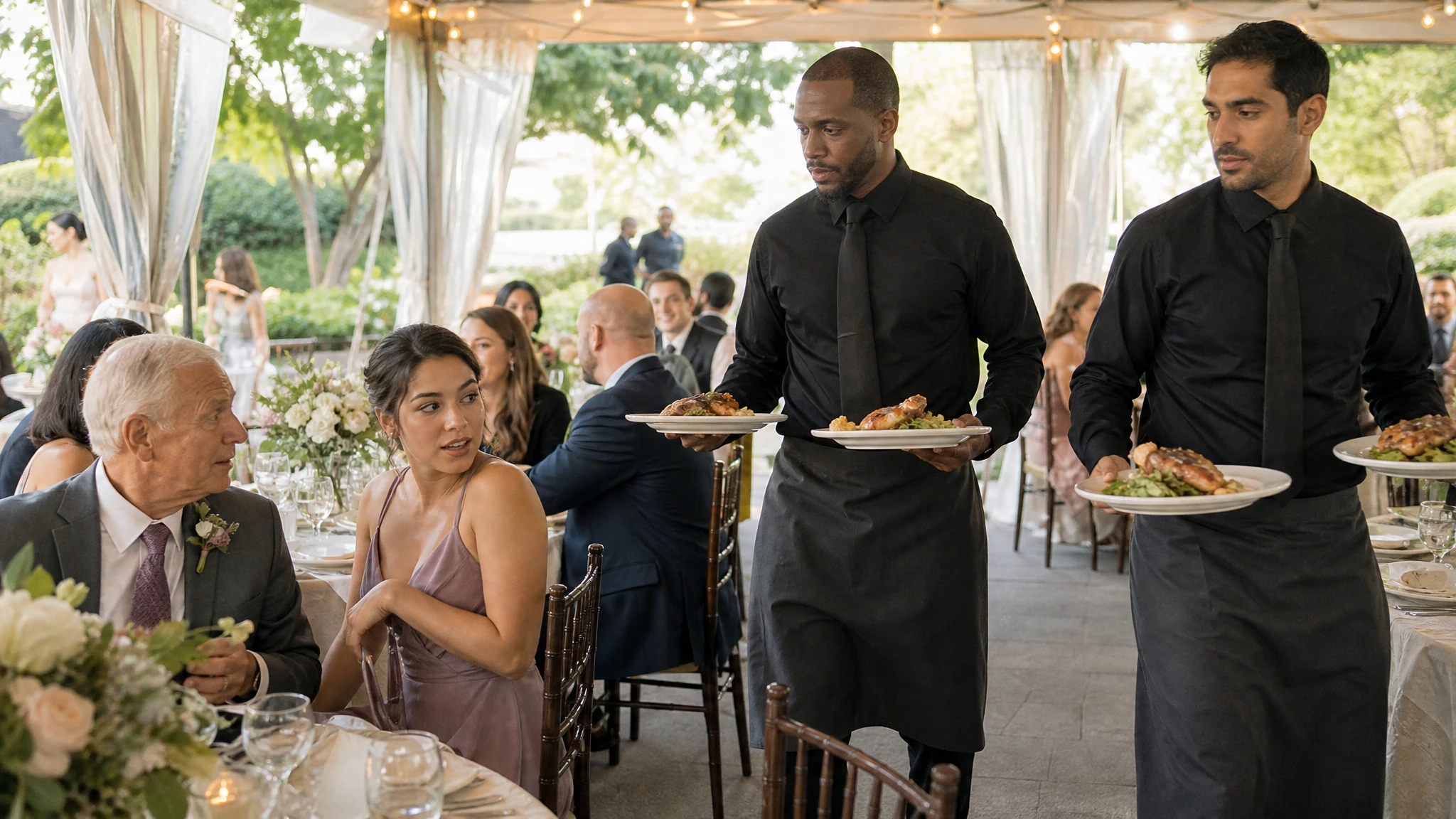
A package bundles food service into your venue booking, and what it contains differs from venue to venue. Ask for a written list of what is and is not included, covering menus, staffing, rentals, service length, cake handling and bar service. Then compare two packages against that same list, not against the headline description each venue gives you.
Costs shift with several factors, and it helps to ask about each one. How the food is prepared and served matters, since a plated dinner, a buffet and food stations call for different kitchen work and different staffing. Staffing changes the total, as do rentals such as tables, linens, china and glassware, and whether those come with the package. If you bring in an outside caterer, ask whether the venue charges fees for outside vendors. Bar service is its own question, because alcohol is a separate permit track in California. A legal checklist for California caterers quotes the Department of Alcoholic Beverage Control: a Type 58 caterer’s permit lets certain retail licensees cater alcoholic beverages off-site, a Type 91 permit lets beer manufacturers cater beer at approved events, and each catered event needs ABC authorization. Treat that as a pointer only, and confirm your venue’s alcohol policy with the venue and with ABC. For reference, we provide bartenders and full bar setup, but we do not sell or supply alcohol. You supply it and we serve it.
Is a Wedding Venue With Catering Included the Right Choice?
A wedding venue with catering included can be a good fit when you value one contract, one point of contact and a kitchen that already works in the space. It can be a weaker fit when your menu needs go beyond what the venue offers. Ask how the venue handles halal, vegetarian and vegan guests, how it handles common allergies, and how the kitchen separates and labels those dishes. No kitchen can promise zero risk, so a clear answer about process is more useful than a blanket reassurance. Ask whether you can taste the menu before you commit, whether dishes can be adjusted, and what happens to leftover food. Also ask how many guests the package is built for and what changes if your guest count moves.
If you find a venue you love that allows outside caterers, a full-service caterer can take on the whole meal. Caterman has served the San Francisco Bay Area from San Jose since 1997, and we offer catering plus event planning across San Jose, San Francisco and the wider Bay Area. More than 80% of what we serve is prepared from scratch in our San Jose kitchen, we accommodate halal, vegetarian, vegan and common allergy needs, and we plan thoughtfully to reduce food waste. For the cake, we do not bake or supply it, but we provide cake service, cutting and plating, for the cake from your own baker. You can look through our menu to see how we cook. Whether we can cater a particular venue depends on that venue’s rules and on local health permitting, so it is worth confirming both early.
Planning Your Event
If your Bay Area venue allows outside caterers, we are glad to talk through your San Jose, San Francisco or South Bay wedding. You can request a quote or look over the menu first.
Frequently Asked Questions
Can I bring my own caterer to a venue with in-house catering?
Often not. Venues with exclusive in-house catering usually require you to use their caterer. Some keep an approved list, and others allow outside caterers who meet county health permitting and the venue’s own requirements. Ask whether outside caterers are allowed, whether they must be on an approved list, and whether the venue’s kitchen can be used, and get the answers in writing.
What should I ask a venue that includes catering?
Ask what the package includes, such as menus, staffing, rentals, bar service and cake handling. Ask how the kitchen handles dietary needs, whether you can taste and adjust the menu, and whether fees apply to outside vendors. Then compare any two packages against the same written list so you are judging like with like.
Does a venue’s health permit cover an outside caterer?
Not automatically. California has had a catering operation category in its retail food code since January 1, 2019, and an outside caterer needs a valid health permit and a permitted kitchen. County rules differ, so confirm the requirements with the county environmental health office where your venue is located.